
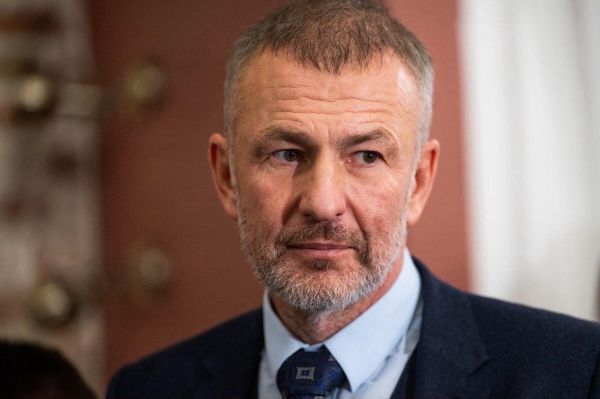
A transcript of an interview with Russian billionaire Andrey Melnichenko, founder of EuroChem, one of the world’s largest fertilizer producers, aired on Russia’s Channel One on 24 September 2026. Speakers: Dimitri Simes, former publisher of the US magazine The National Interest (host); Andrey Melnichenko (guest).
Dimitri Simes: This is a special analytical edition of “The Great Game.” We will talk with Andrey Igorevich Melnichenko – a very successful entrepreneur. Like every successful entrepreneur of a large scale, he is under Western sanctions, the grounds for which I long ago stopped trying to understand. Recently, a major piece was devoted to him in the English magazine The Economist – a publication that is not known for its sympathies toward Russia. The article acknowledges that Andrey Igorevich is not an opponent of the Russian authorities and does not try to present himself as an opponent of the war. At the same time, he is spoken of with great respect – as a serious, thoughtful person and, as I want to add, a true patriot of Russia. In your interview and the article published in The Economist, you expressed, from my point of view, a whole series of reasonable thoughts about why the West should not try to inflict a defeat on Russia and how such attempts could harm the West itself. But we are primarily interested in the extent to which the West is capable of listening to reasonable arguments. What is required for your voice to be heard there and, more broadly, the voice of Russia? So far, I – as, it seems to me, both the Russian authorities and analysts like me – have the impression that we are heard, but at the same time they think only about how to refute and ignore our arguments. What is your impression?
Andrey Melnichenko: There is probably no simple answer here. Indeed, today Western elites in general treat Russia, to put it mildly, in an unfriendly manner. This, of course, imposes certain constraints. But should we try to change such an attitude? Are there any chances of changing it? I think the question should be posed differently. To force oneself to be understood or liked is not quite the right task. It is far more correct to change the balance of risks and interests that has developed between us and the West. It is precisely work on changing this balance that should be the goal of continuing dialogue through all available channels of communication.
Dimitri Simes: It seems to me that for a person like you, it is rather difficult to conduct a dialogue with European elites. You are a physicist, in your early youth you became a successful entrepreneur, an international businessman. You think logically and systematically, you analyze risks and opportunities. But a whole series of analysts, including me, have the impression that European elites easily depart from logic and even forget about their own interests. Russophobia prevents them from thinking rationally. What is your impression? Are these elites with whom it is even possible to conduct a real dialogue?
Andrey Melnichenko: I think that the notion of a “united West” does not exist. The West, like any complex society and any complex structure, is fragmented. It is divided in terms of various political and economic interests. It is a conglomeration of interests. The task is to understand these interests. To understand does not mean to conform to them. One must always proceed from one’s own interests. But by understanding the language of the interlocutor, one can, as I already said, change the balance of risks and interests. That is probably what one should be doing.
Dimitri Simes: From my point of view, this is a very rational thought. But you also noted in your interview and article for The Economist that in order for your arguments to be heard, it is necessary to convince the interlocutor of the ability to defend one’s own positions and of readiness to show firmness. On the other hand, you expressed concern that further escalation could lead to an expansion of the conflict and to the most unpleasant – possibly catastrophic – consequences. Yesterday I read a speech by U.S. Secretary of State Marco Rubio. He essentially repeats your thoughts: there is a real danger of escalation that probably no one wants and that no one needs. But such a danger exists, and it must be reckoned with. How, in your view, can one simultaneously demonstrate resolve and avoid dangerous escalation?
Andrey Melnichenko: If there were a simple answer, it would probably already have been found. But there is no simple answer here. It seems to me that the very structure of negotiations and dialogue must to a certain extent be changed. It should be looked at somewhat differently. What are classical structures of negotiations like? There is a deal, when the parties try to find benefit for each of them. There are negotiations in the course of which the parties seek compromises, the possibility of avoiding something or, on the contrary, finding something in common. But there also exists such a structure of conversation as a project. How does a project differ from the previous two types? In this case, the initial conditions – where you are – and the final goal are more or less clear. And the goal in this case is obvious: to find the possibility of coexistence in a new world that is becoming increasingly unsafe. It is precisely the word “project” that probably describes the method that should be used here. Negotiations are when you sit on opposite sides of the table and resolve your issues by comparing positions. And a project is when you sit on one side of the table, and on the other side is the problem. The solution to the problem may be unknown, but if it is formulated what exactly needs to be solved, and the two sides work together on this task, a solution, as a rule, is found. Sometimes it turns out to be the most unexpected.
Dimitri Simes: Provided that both sides are interested in finding a solution. When I read about you, familiarized myself with what you wrote, and listen to you now, I imagine that you could be very effective in a conversation with Henry Kissinger or Richard Nixon. But when I think about the current European elites, I am not sure about that. I never personally met Ambassador Anatoly Dobrynin, but I know that he was a man of great intellect and a true professional. Not only Kissinger, but also Nixon, as president, regularly met with him. I am trying to imagine Dobrynin talking with President Biden. And even more so Dobrynin in a conversation with Chancellor Merz. These are people of completely different intellect and completely different type. How does one deal with those who are not ready to seek constructive solutions, even if such a solution serves their interests?
Andrey Melnichenko: There are two formulas here. The first is to change the balance of risks and opportunities.
Dimitri Simes: But then the danger of escalation appears.
Andrey Melnichenko: The key word is “balance.” To go only in one direction, without taking the other into account, means destroying the balance. To seek balance is something else: to find certain solutions. You have just focused attention on the role of leaders — Biden, Nixon, and others. In the Russian and Western traditions there is a tendency to personify the activity of such large political subjects as the state, linking it to the actions of leaders. But that is not quite so. Society is far more complex. A leader far from always determines the course of history. To a certain extent, the archetype of a leader corresponds to the state of society at a particular moment. For example, in the Russian — or, more precisely, civilizational — tradition, the concept of a leader is connected with the concept of mission. There is a historical mission, and the leader must correspond to it. Therefore, in the Russian consciousness, the view of a leader is at the same time a view of mission. We reason within this system of coordinates. In the democratic societies of the West it may be somewhat different. Personification there is less pronounced, and society is more fragmented. If you see that your interlocutor does not hear you, two questions arise here. Of course, there is a question for the interlocutor: it is more pleasant to deal with someone who understands you, shares your values and views. It is far more difficult to find solutions in a world that has become fragmented, where various interests, civilizational codes, and perceptions exist. But this is precisely the work that must be done.
Dimitri Simes: I can imagine your conversation with President Trump. He is, of course, a special person: self-absorbed, sometimes capricious, he likes to be unpredictable. But, like you, he has extensive experience in business. He understands: if a deal serves your interests, you need to seek creative solutions and a balance of interests. Therefore I can see how Trump often makes broad statements, sometimes issues threats in caricatured form. But in the end he understands that certain things cannot be done, and certain things must be done. This has led to a situation where, despite the fundamental and enduring contradictions between Moscow and Washington, the presidents of the two countries conduct a serious dialogue. It seems to me that Trump treats Vladimir Putin with respect. And I am sure that Putin treats Trump with respect and understanding — with open eyes regarding whose interests Trump represents and what can be expected from him. Putin behaves like a rational leader. But when I look at European leaders, I am not sure how far one can rely on them following Karl Marx’s formula: being determines consciousness. It seems to me that their consciousness is often disconnected from being. You rightly said that one should not focus too much on leaders: the real decision-making mechanisms in European countries are significantly more complex. But how does one understand the colossal sanctions imposed against Russia, especially in the energy sphere and, in particular, against Russian gas? It would seem that both for the population of Germany and for German business circles, Russia was a quite reliable partner. I, at least, have not seen complaints from German businessmen or consumers about how Russia acted as an economic partner of Germany. And all of this was so easily cast aside. Why?
Andrey Melnichenko: Because the world is more complex. Everything does not come down to a deal and economic benefit. If we speak about political processes in Europe as I understand them, society there is changing very quickly. Technologies are changing, the speed of information dissemination, the nature of challenges. All of this is happening extremely quickly. When changes happen quickly, uncertainty, fragmentation, and nervousness arise in society. A need appears to simplify what is happening, to find some explanation for it. One of the simplest ways is to find an image of an enemy, an external enemy. Such an image allows society to be consolidated and internal contradictions to be held in check. Unfortunately, in the perception of a number of European countries, we have become such an enemy. Russia has turned into a convenient enemy for the elites of these societies — into an instrument for consolidating political unity. In my view, this is precisely what happened. This is a big problem, because in such a situation emotions defeat rationality. If we speak about the logic of President Trump, you indeed described him as a businessman. But there exist different ways of doing business. There is a method that Trump himself described in detail in the 1980s: creating imbalance. You create uncertainty in your opponent, demonstrate that he does not know what to expect from you, and thanks to this you extract benefit from the deal. This is not the only possible method of doing business, but it is a possible one. I am far more impressed by the approach that, for example, the Russian Federation adheres to. In my view, it corresponds more to an attempt to speak in the language of a project: to seek a solution to the problem and propose a structure that could answer the questions that arise. These are simply different approaches. We live in a world where economic globalization will not end. It is beneficial, and the economy continues to develop. The International Monetary Fund speaks of three percent growth of the world economy this year. Economic globalization continues. Goods still move along supply chains, perhaps more complex ones. But at the same time, political fragmentation has occurred. The existence of economic globalism does not mean the existence of a single political system. This is precisely what we today call a multipolar world. If the world is multipolar, one should not expect that others will be the same as we are. They will think and act in their own interests, proceeding from their own system of priorities. We must think about our interests and our system of priorities, and find a model of survival in this new, unsafe world. Moreover, what is at issue should be not simply survival, but development and movement forward. One should not force anyone to love you or understand you. One must clearly follow one’s own interests, understand them, and see further than one’s counterparts see. If there is an understanding of the goal and confidence in it, the road will lead to that goal one way or another.
Dimitri Simes: There is an English expression: “A tongue without arms — how dare you speak?” In other words, if you have no power or weapons, why do you even allow yourself to speak out? [Translator’s note: the Russian “язык без рук” is literally “a tongue without arms” — a voice with no force behind it; the host presents it as an English expression, though it is not idiomatic English.] It seems to me that this is precisely the dilemma of Russian foreign policy. If we create the impression that we genuinely threaten the United States, Europe, and the West, that impression is exploited to the maximum: they stir up their own populations, militarize their economies, and take various actions against Russia. But if we say, “Let’s return to international law. We live on one planet and face common threats. There was COVID, now artificial intelligence may spiral out of control, there are climate threats. Let’s tackle these problems together,” then I get the feeling that they hear us in a completely different way from what we mean. They hear that we are weak and indecisive. And that, in their view, contradicts their interests. You used the key word “balance.” As you know, that was Kissinger’s favorite word. But the Kissinger era in America is over. How does one seek balance in such a situation?
Andrey Melnichenko: Indeed, I would like to know. One needs to think about what the world will look like some time from now. It is on the threshold of great changes and is already going through them. We are moving toward a world in which political systems will be fragmented. Different systems will develop in accordance with their own codes and principles. In this world, one should not set as a goal to be fully understood. Nor should one deceive oneself with the illusion that one can precisely understand and account for the interests of all others. It seems to me that in the world we are entering—not because we want it, but because it is objectively becoming so—the key concept will be sovereignty. What does that mean? Above all, the ability to make decisions in one’s own interests. Russia has withstood. You mentioned sanctions and other measures of pressure. We have demonstrated the resilience of our political and economic systems despite everything that has come down on us. In that sense, security was ensured. But the next question is how to ensure security of development. How to make it so that we develop, so that the word “sovereignty” is filled with concrete content? Sovereignty is the ability to act in one’s own interests, to make decisions in the way that benefits you. What does “you” mean? It means giving citizens a planning horizon and a certain predictability. Secondly, ensuring the ability to develop technology, means of production, industry, and the education system. It is into domestic matters that sovereignty must be transformed. If you mind your own business and are interested in your own development, then everything else, including foreign policy, comes down to one question: how to ensure the conditions that allow you to pursue that development. That is the main goal of foreign policy.
Dimitri Simes: French President Emmanuel Macron recently said something that alarmed me greatly. He said that Russia represents an existential threat to Europe and, more specifically, to France. When people speak of existential threats, it is implied that even military action may be permitted to counter them—including preemptive action. If Macron really meant what he said, do you think that he and other European leaders are preparing for war with Russia? Not a war that Russia might start against them, but a war that they intend to start against Russia?
Andrey Melnichenko: Europe is militarizing—that is a fact. Military spending is growing, rhetoric is intensifying. This has become an important instrument for mobilizing Western European societies. The question is whether this fact will be transformed into a reality that in fact is needed neither by us nor by them. Preventing a negative scenario is our task.
Dimitri Simes: I very much like your manner of thinking—the constant search for balance. I want to ask another question. Under sanctions, Russia has found ways to uphold its sovereignty through self-sufficiency. It is impressive how our country manages this. But if one thinks about the long term, do you not fear that we will be able to solve specific tasks, especially in the area of weapons development, but that this will hinder development overall—not only in comparison with the United States, but also with China and India?
Andrey Melnichenko: Of course I fear it. It seems to me that total self-sufficiency and a fully autonomous system are not the solution. Here again one must seek balance. On the one hand, there is a bloc of critically important technologies and basic means of production. It is also important to control one’s own national payment system. There are areas in which you must be fully protected from any external influence. Either you need to have your own solutions, or several reliable suppliers. There must be several of them. That is one bloc. On the other hand, full self-sufficiency is not the solution. To be economically efficient and competitive, one must participate in the exchange of goods, technology, and knowledge. But at the same time, one must not create new dependencies. Thus, on the one hand, a balance of security in critically important areas is necessary, and on the other, sustainable development that does not create new dependencies. If this balance is maintained, that is the right path. If it is disrupted, problems arise: either risks grow, or development slows, which ultimately leads to falling behind developing countries.
Dimitri Simes: Under sanctions, it is especially important to preserve the right dynamics of economic growth, and this largely depends on investment. Investment, in turn, depends on the key rate. I don’t need to tell you this—you know it far better than I do: there is a direct link between economic growth rates and the preservation of fiscal stability. On this matter, opinions in Russia, including within the government, differ. What is your approach?
Andrey Melnichenko: What are we observing now? The global economy has not been destroyed by the two ongoing wars. The conflict in the Middle East has led to rising risks and costs in energy, maritime logistics, and insurance. The events related to the conflict in Ukraine launched a different phase—processes of fragmentation caused by sanctions and technological restrictions. The world economy has adapted to these changes, but it does so at the cost of rising expenses. Goods continue to move, but if previously a company needed only one supplier, now it needs three. Previously one could operate with minimal inventories on a just in time basis, but today one has to accumulate excess reserves. States also have to bear additional expenses and create backup systems to perform certain functions. In other words, costs are rising in the world economy, and the consequence of this is rising costs in national economies and inflation. This is cost-push inflation. When we begin to fight inflation without affecting production costs and expenses on the supply side, but instead use methods that were correct in a different economic situation, we encounter a problem. This is about a world that was open and fully global, without significant restrictions. Back then, fighting inflation by reducing demand could be effective. Changing the key rate does affect demand: investment and consumer demand decline. It seems to me that these methods are meant for another world—one that is gradually becoming smaller and smaller.
Dimitri Simes: And the last question—precisely about the world that perhaps still exists. We continue to think in the categories of the current world. It is well known that generals always prepare for the previous war. The conflict that everyone was preparing for in Ukraine differs substantially from what is actually happening. It seems to me that political scientists, statesmen, and society as a whole think as if what is happening today represents a long-term and most probable trend. But that is not always the case. This brings me to the thought of artificial intelligence. As you probably know, the physicist Stephen Hawking in the last year of his life warned that compared with the threats associated with artificial intelligence, all existing dangers may seem insignificant. You are a physicist and possess very disciplined thinking. Are we underestimating the danger of artificial intelligence?
Andrey Melnichenko: We do not know. Let us say it plainly: we do not know. But here is what seems to me. In moments of great uncertainty, when information flows and moods in society change rapidly, fear indeed becomes one of the instruments of consolidation. It makes it possible to ensure control over society, its stability, and its manageability. In my view, it would be far better to fear climate change. In the early 1990s, after the end of the Cold War, this process, launched by Margaret Thatcher, developed actively, rather than continuing to fear the Cold War and nuclear annihilation.
Dimitri Simes: But that was ignored.
Andrey Melnichenko: Why? For a time this direction developed actively—for roughly twenty years. Whether there is real substance behind it is another question. But the threat of annihilation as a result of a major nuclear war was replaced by another problem around which humanity tried to consolidate. It seems to me this is a positive process. Humanity needs a common enemy. One was found, but it turned out to be far safer.
Dimitri Simes: Maybe we should focus on artificial intelligence?
Andrey Melnichenko: After that we tried to focus on fighting diseases. For example, the COVID-19 pandemic. There was a lot that was unpleasant about it, but everyone was concerned and fighting a common threat. Then for a while people talked about aliens: we need to consolidate because we will be attacked from space. If society really must be consolidated, let humanity focus on some other danger, rather than on destroying Russians on the pretext that they will attack Europe, or on destroying someone else on the pretext of a possible attack on China. Let us focus on the problem of artificial intelligence. I like that much more than concentrating on the threat emanating from some state or person against whom some action must be taken because of a misunderstanding.
Dimitri Simes: I completely agree. I am not a physicist and I cannot judge what opportunities and, even more so, what dangers artificial intelligence presents. But I believe that this is an area where we have no right to underestimate either the opportunities or the risks. Thank you very much for this conversation. It was very interesting. Your position gives grounds for optimism: there are people with such an approach, and they are ready to listen to you even in godforsaken London. Thank you very much. We are going to a commercial break.
