
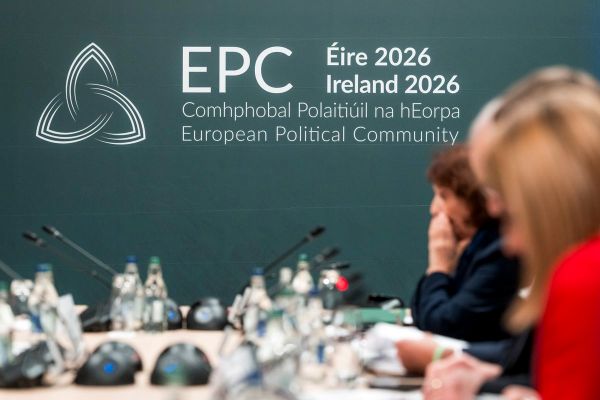
Leaders from over 40 European countries convened by the River Liffey in Dublin on Thursday for a summit that centred on the continent’s precarious security situation. This gathering occurs against the backdrop of a new United States-backed initiative aimed at facilitating discussions to resolve the ongoing Russia-Ukraine conflict.
The European Political Community (EPC) summit brought together heads of state and government from the European Union and other European countries, including the United Kingdom. Prominent attendees included Ukrainian President Volodymyr Zelenskyy, Canadian Prime Minister Mark Carney, and NATO Secretary-General Mark Rutte.
Irish Prime Minister Micheál Martin said the EPC was established to address increasing regional and global political instability and to foster a more unified approach to the challenges facing Europe. This summit provides a significant opportunity for President Zelenskyy and European allies to reflect on the outcomes of the recent US-mediated talks held in Abu Dhabi, which focused on the near five-year-long conflict in Ukraine.
American representatives Steve Witkoff and Jared Kushner were scheduled to meet with President Zelenskyy in Dublin following their discussions with Russian President Vladimir Putin in Moscow. However, ahead of the meeting, Zelenskyy expressed cautious scepticism about progress toward peace, noting, “Yesterday, the Russians stated they had no authorisation to discuss measures that could alleviate the suffering caused by this war.”
The EPC is focused on security
The European Political Community (EPC) was established in 2022 through the collaborative efforts of French President Emmanuel Macron and former German Chancellor Olaf Scholz. This forum was created as a platform for both EU member states and non-EU countries, in response to the significant security challenges posed by Russia’s full-scale invasion of Ukraine. A pertinent topic of discussion has been the need for European countries to have an envoy in peace negotiations, as there is concern about potential exclusion from discussions critical to the continent’s future. However, Russia has expressed reluctance to include European states in these direct negotiations.
The EPC brings together nearly 50 countries across Europe, excluding Russia and Belarus, and has also evolved into a forum for dialogue on European security issues. This is particularly relevant in light of US President Donald Trump‘s return to office in 2025, which raised concerns among European leaders because of his critical stance toward NATO allies and his remarks about Greenland, a semi-autonomous territory of Denmark.
Canadian Prime Minister Carney’s participation in the EPC indicates a desire to strengthen ties with Europe, particularly following the trade tensions initiated by Trump and comments regarding Canada becoming the 51st state of the US. Similarly, UK Prime Minister Andy Burnham is exploring closer ties with the EU nearly six years after the United Kingdom left the bloc. The EPC offers the UK an opportunity to engage in significant European political discourse despite Brexit’s implications.
Critics have characterised the EPC as a mere “talking shop.” The forum convenes twice a year, once in an EU member state and once outside the bloc, with the next meeting scheduled for April in Zurich, Switzerland.
Detractors allege that the EPC impedes EU enlargement by offering a platform at a prominent European forum without the full benefits of membership. Others argue that the discussions often lack substantive outcomes, since meetings do not result in binding decisions or formal declarations. Nevertheless, during his address welcoming fellow leaders at a convention centre in Dublin’s revitalised docklands, the Irish Prime Minister emphasised that it would be a misstep to underestimate the EPC’s significance.
“Very often (at) these informal networking get-togethers a lot can happen,” Martin said. “A lot can emerge.”
Meeting under rising hybrid attacks
The meeting comes amid political upheaval in Europe and after Republican losses in the US midterm elections, which have weakened Trump’s domestic control. It’s unclear whether this setback will influence his approach to the war in Ukraine or the conflict with Iran.
Recently, populist leaders in Serbia and Hungary have been ousted, while the EU and Britain are working to rebuild ties after Brexit. Despite this, the far right is gaining ground in Europe, particularly in recent regional elections in Germany. Voters in major countries like Spain, France, Italy, and Poland are set to vote in the coming months.
Security discussions will also address hybrid threats from Russia, which has been accused of disruptive attacks on critical infrastructure. Recently, several European airlines and media outlets received hoax bomb threats, targeting Ryanair and Ireland’s national broadcaster RTE. European countries have not yet assigned blame for these incidents.
The Irish government noted that the European Political Community (EPC) meeting is the largest gathering of international leaders ever held in Ireland and is accompanied by a significant security operation by its national police force, the Garda Síochána.
This article used information from The Associated Press.
