
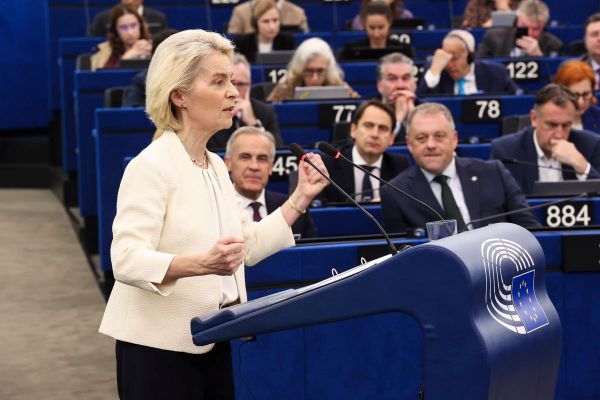
Von der Leyen’s State of the Union and the EU’s struggle to turn geopolitical ambition into political action
Ursula von der Leyen’s latest State of the Union address to the European Parliament contained an unusually clear diagnosis of Europe’s predicament. Speaking in Strasbourg on September 16, the President of the European Commission argued that Europe’s “doctrine, institutions and decision-making have not kept pace with the new reality” and that its systems were designed for “a different world.” She called for a Europe with “the power to act” – stronger in defence, more resilient economically and better prepared for a growing range of security challenges.
This is an important admission. But it also raises a question the speech did not fully answer: if Europe’s institutions are no longer fit for the strategic environment in which the Union has to operate, what needs to change?
The answer cannot be limited to higher defence spending, new security instruments or better coordination among member states. Europe’s deeper problem is political and institutional: it increasingly understands what it needs to do, but its decision-making system often prevents it from acting with the speed and coherence that the new international environment demands.
The war in Ukraine, the changing relationship between Europe and the United States, Russia’s challenge to the European security order and the growing importance of power politics have compressed the time available for European decision-making. Yet the Union continues to rely, in some of its most sensitive areas, on procedures designed for a more predictable world.
Von der Leyen’s speech itself illustrates this tension. She announced plans for a new European security strategy and a European emergency security protocol, while calling for stronger cooperation with NATO. At the same time, she acknowledged that the Union’s institutions and decision-making procedures have not kept pace with the new reality.
The question, therefore, is straightforward: how can the EU become a geopolitical actor if, on some of the issues that matter most, one national government can still prevent the other 26 from acting?
The EEAS: a symptom rather than the disease
The debate over the European External Action Service (EEAS) illustrates the problem. Created in 2010, the EEAS was intended to give the Union a more coherent external presence. Yet it remains a hybrid structure, operating between the European Commission and the member states, while the High Representative for Foreign Affairs and Security Policy is simultaneously a member of the Commission and chair of the Foreign Affairs Council.
This architecture has never fully resolved the tension between a common European foreign policy and the continuing predominance of national foreign policies.
There are now proposals for reform, including efforts to improve coordination between the EEAS and the Commission and strengthen the role of the High Representative. Such changes may reduce duplication and improve efficiency. But institutional rearrangement alone will not solve the fundamental problem.
The real issue is not simply who manages European foreign policy. It is how decisions are made.
The veto problem
Foreign and security policy remains one of the areas where unanimity is still the dominant rule. This reflects a legitimate concern of member states: foreign policy touches directly on national sovereignty and strategic interests. But unanimity also means that a single government can block a common European position, even when a large majority of member states believe that collective action is necessary.
That tension has become increasingly difficult to sustain.
An initiative by eleven member states has called for exploring ways to move beyond obstructive vetoes and make greater use of qualified majority voting in foreign policy.
This would not automatically create a common European foreign policy. Member states would still have different strategic cultures, geographical priorities and national interests.
But there is a fundamental difference between disagreement within a system that can ultimately take a decision and disagreement within a system that can prevent a decision altogether.
For a Union that increasingly wants to act as a geopolitical power, that distinction is becoming critical.
Strategic autonomy requires decision-making capacity
The debate over European strategic autonomy is often framed as a question of defence spending or military capabilities. These are essential. Europe needs stronger defence industries, greater joint procurement, more effective military capabilities and a stronger European pillar within NATO.
But strategic autonomy is not simply about what Europe can buy. It is also about whether Europe can decide.
The EU may increase defence expenditure, expand its industrial capacity and mobilise significant financial resources for Ukraine. Yet capabilities cannot compensate indefinitely for political paralysis.
Money can buy capabilities. It cannot remove a veto.
Strategic autonomy should therefore not be understood as an alternative to the transatlantic relationship. The issue is not whether Europe chooses the United States or chooses autonomy. It is whether Europe possesses sufficient political and institutional capacity to act when its interests require it – including within the transatlantic alliance.
The changing international environment makes this increasingly important. Europe can no longer assume that Washington will always provide the strategic framework, the security guarantees and the political leadership on which European governments have traditionally relied.
That does not make the United States irrelevant. It makes European capacity more important.
A political window that will not remain open forever
The current debate takes place against a broader transformation of European politics. Governments face growing domestic pressures, nationalist and Eurosceptic forces remain influential in several member states, and the relationship between Europe and the United States is being renegotiated.
This creates both pressure and opportunity for institutional reform.
There is a growing recognition that the European Union cannot simply respond to every new crisis by creating another temporary mechanism or finding another compromise between national positions. At some point, the institutional architecture itself has to be addressed.
The danger is that political urgency will once again be followed by institutional inertia.
Reform requires political capital. Changing the way the Union takes decisions inevitably touches national sovereignty, treaty arrangements and the balance between member states and common institutions. It therefore cannot be achieved through administrative adjustments alone.
But the opposite is also true: refusing to discuss institutional reform is itself a political choice.
Matching ambitions with resources
The forthcoming Multiannual Financial Framework will provide another test of whether Europe is prepared to match its geopolitical ambitions with concrete instruments.
The Commission has proposed a budget of almost €2 trillion for the 2028–2034 period, including substantial allocations for defence, security and space, as well as significant support for Ukraine.
The figures matter. But so does the political logic behind them.
If Europe is increasingly convinced that security, defence, technological capacity, economic resilience and support for Ukraine are interconnected, then its budgetary priorities will have to reflect that understanding.
Yet here again the same question returns: can the Union mobilise resources more effectively if its political institutions remain unable to take timely collective decisions?
The answer cannot simply be more money. It must also be greater capacity to decide where and when those resources should be used.
Europe’s next integration question
For decades, European integration progressed primarily through the creation of common rules, a common market and common economic institutions. Foreign policy remained much more closely tied to national sovereignty.
The strategic environment is now challenging that division.
Europe is increasingly expected to behave as a political actor: to respond to wars on its borders, manage relations with major powers, protect critical infrastructure, strengthen its defence industry, secure supply chains and respond to economic and technological competition.
These responsibilities cannot easily be reconciled with an institutional system in which collective action can repeatedly be delayed or blocked by national vetoes.
This does not mean that Europe should become a centralised state or that national foreign policies should disappear. Nor does it mean that every foreign-policy issue can or should be decided by majority vote.
It does mean that the Union needs to decide where national sovereignty must remain decisive and where common European action requires different decision-making mechanisms.
That is the deeper question behind the current debate over the EEAS, qualified majority voting, defence and strategic autonomy.
Europe’s problem, ultimately, is not a lack of ambition. Von der Leyen’s speech demonstrated that European leaders increasingly understand the scale of the challenge. The more difficult step is to draw the institutional consequences of that diagnosis.
The Union’s political machinery was largely designed for a world in which Europe had more time to negotiate, more predictable partners and fewer immediate strategic pressures.
That world is disappearing.
If Europe wants to act in the new one, it will need more than declarations of unity. It will need the institutional capacity to decide.

Theodoros Tsikas
Mr. Theodoros Tsikas is a Political Scientist and International Relations Expert, Head of the Programme "Theory and Practice of International Relations" at the Institute of International Economic Relations (IDOS/IIER), Greece.
