
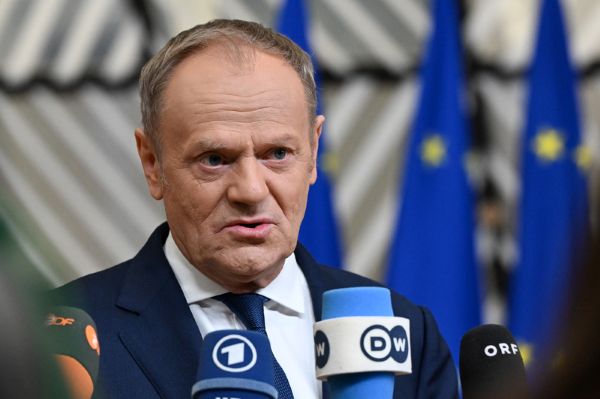
Polish Prime Minister Donald Tusk said on Tuesday that Poland effectively mitigated what appeared to be an attempted provocation along its border with the Russian exclave of Kaliningrad overnight. Although details were limited, he reported sightings of “individuals with flashlights” in the border area, emphasising that Polish guards prevented any incidents.
As NATO’s largest member on the alliance’s eastern flank, Poland shares borders with the Kaliningrad exclave to the north and Belarus, a close ally of Russia, to the east. Tusk said that shortly after midnight, he received notifications from border guards about “disturbing movement” observed along the Polish-Russian border.
In light of heightened security concerns, Polish police, in collaboration with military forces, border guards, and intelligence services, have enhanced operations to reinforce security in the northeastern regions of Warmia-Masuria and Podlaskie, particularly near the Russian exclave. Tusk confirmed that police coordinated a special operation in these border areas.
Additionally, Tusk noted that further police and military personnel, including counter-terrorism units, have been deployed to the northeastern border after receiving “more precise” intelligence suggesting possible sabotage or incursions by “armed individuals” in the first half of November. He highlighted that information has been consistently received from both Polish and allied intelligence services, indicating the potential for diversionary actions or serious provocations along the border with Russia.
Tusk also said he received additional warnings about possible escalations from General Alexus Grynkewich, NATO’s Supreme Allied Commander in Europe, during a recent visit to Warsaw in October. He has cautioned for several months about the potential for Russia to prepare for a more significant hybrid attack against a NATO member state. His alerts have become increasingly detailed as a result of intelligence received from NATO, Ukrainian, and US agencies, including the CIA.
In conclusion, Tusk acknowledged that while it remains challenging to confirm with complete certainty that the recent incident was an attempted provocation, he expects Russia’s escalatory actions to persist and are unlikely to be confined to this single incident.
This article used information from The Associated Press.european interest
