
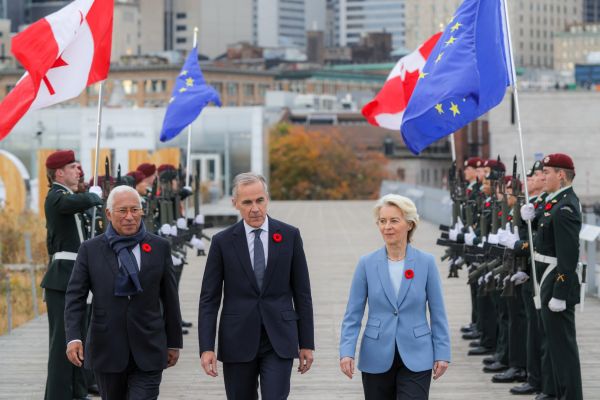
Canadian Prime Minister Mark Carney said Friday he expects to finalise negotiations with the European Union in June on a major partnership that would designate Canada as the EU’s first “associate member.” However, this designation was not included in the joint declaration that launched a new economic and security alliance.
PM Carney said he intends to participate in an upcoming meeting of European leaders in June to conclude discussions on this proposed relationship, which would not entail full EU membership.
“In parallel, we are working towards the deepest possible partnership, short of accession — with Canada becoming the European Union’s first Associate Member,” Carney said.
At the conclusion of a two-day summit in Montreal, the joint declaration did not address associate membership. Instead, the leaders agreed to work towards defining an “ever-closer association” by their next summit in 2027.
European Council President António Costa remarked that this alliance represents the closest relationship the European Union has established with any country outside the bloc. The focus will be on enhancing cooperation in trade, research, and security, particularly in light of the challenges posed by US President Donald Trump‘s trade policies, which have strained relations with traditional allies.
Additionally, European Commission President Ursula von der Leyen stated that shared values take precedence over geographical proximity in determining which countries should collaborate effectively.
“It is not so important where the countries are on the map,” von der Leyen said. “What is important are the values that a country defends and where countries stand in international relations.”
Carney said the proposed alliance would strengthen Canada’s and Europe’s sovereignty and help them weather economic shocks.
“And it means, at its base, sovereignty, greater resilience, an ability to withstand shocks together,” he said.
Ursula von der Leyen has been actively advocating for Canada to become the European Union’s first “associate member.” However, various European governments have resisted the proposal. Mark Carney has also used this terminology, though he has emphasised that the partnership’s advantages matter more than the label itself.
“We want Canada as close a partner as possible to the European Union,” von der Leyen said. “We know that Canada cannot be a full-fledged member of the European Union, but to have a relationship as close as possible, this is our goal.”
Carney said the proposed alliance would make life more affordable, expand consumer choice, and create opportunities for businesses and researchers. Von der Leyen mentioned that Canada and the EU are establishing partnerships to address issues like critical minerals, supply chains, artificial intelligence, and space. They are expected to announce a digital trade agreement and initiatives for scientific research partnerships and student exchanges.
Von der Leyen also noted that Canadian companies will gain access to Europe’s supercomputer network for AI development. Trump has warned that Canada’s arrangement with the EU could be viewed as a “hostile act,” threatening tariffs if deemed unfriendly. In 2025, the US accounted for 71.7% of Canada’s merchandise exports, presenting challenges for Carney as he aims to double exports to other countries in the next decade.
This article used information from The Associated Press.
