
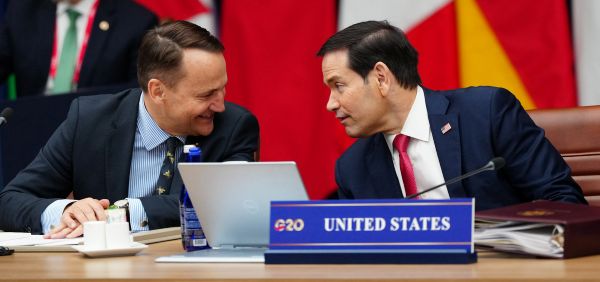
Diplomats from the Group of 20 (G20), the world’s largest economies, concluded two days of discussions in Atlanta on Saturday without reaching consensus on several critical global security matters. Divisions, particularly over Russia’s military actions in Ukraine, notably affected the meeting. As a result, the Group opted not to release a joint communiqué and will instead issue a chairman’s statement that summarises the discussions. Secretary of State Marco Rubio will deliver the statement at the conclusion of the talks.
During the opening remarks, Rubio emphasised the importance of unity. However, he ultimately cancelled the customary group photo of foreign ministers on Friday after European diplomats objected to including Russian Foreign Minister Sergey Lavrov. They said they intended to boycott or withdraw from the photo opportunity, which is typically standard practice at such gatherings.
Polish Foreign Minister Radosław Sikorski, representing his country as a guest at a G20 meeting for the first time, said he was not surprised by the difficulty of reaching consensus.
“We have wars going on, and we have participants in those wars around the table, so it’s very difficult to agree on a common line,” he told reporters.
Participants in the recent meetings, who spoke on condition of anonymity because of the confidential nature of the discussions, said they had collectively agreed to set aside differences and work together to make the upcoming G20 leaders summit, hosted by President Donald Trump in Florida, a success.
These diplomats said a chairman’s statement was expected, given the substantial divergences among attendees on key issues such as the Russia-Ukraine conflict, the US-Israeli approach to Iran, US tariffs, and Chinese activities in the South China Sea. These matters have contributed to higher global fuel costs and ongoing trade uncertainty.
While they described the opening session as cordial, they noted that Russia’s stance on Ukraine remains steadfast, as does its opposition to Poland’s participation in the G20. The discussions also highlighted disagreements over the Trump administration’s decision to exclude South Africa, a G20 member, despite objections from various parties.
Russia’s presence concerns Europeans
Several G20 countries have expressed concerns regarding the US invitation extended to Russia amidst its ongoing escalations in Ukraine. This situation has been further complicated by Trump’s previous decisions, which included waiving new sanctions on Moscow and placing temporary restrictions on logistical and intelligence assistance to Ukraine.
Nonetheless, the State Department announced on Friday the approval of a proposed $2.1 billion sale of Patriot air defence interceptors to Ukraine.
Russian Foreign Minister Sergey Lavrov has asserted that Moscow will not accept any scenario in which Ukraine poses a military threat to the legitimate security interests of the Russian Federation. Since Russia invaded Ukraine in February 2022 and the subsequent imposition of severe sanctions on Moscow, Lavrov has infrequently visited NATO member states.
Additionally, it remains uncertain whether President Vladimir Putin will accept the invitation to attend the G20 leaders’ summit at Trump’s golf club in Miami this December.
Freedom of navigation at the core of the G20 December meeting
The United States has identified resolving differences over freedom of navigation as a primary focus for the upcoming meeting. Key areas of concern include the Strait of Hormuz, the Red Sea, the Black Sea, and the South China Sea. Discussions will cover critical issues related to Iran, the Russia-Ukraine conflict, and China’s interactions with its smaller neighbouring countries.
A significant consideration for this meeting is the possibility of renewed US military intervention in Iran, which has generated a sense of unease in the region, including among G20 member Saudi Arabia. Rubio has held sideline discussions with Saudi Foreign Minister Prince Faisal bin Farhan, as well as Turkish Foreign Minister Hakan Fidan, whose nation has played a vital role as a mediator.
Furthermore, reports from the Associated Press indicate that US officials have advised several countries in the Middle East and regional allies to prepare for potential military actions against Iran following the midterm elections. There are also concerns regarding possible retaliatory actions from Iran against these countries.
This article used information from The Associated Press.
