
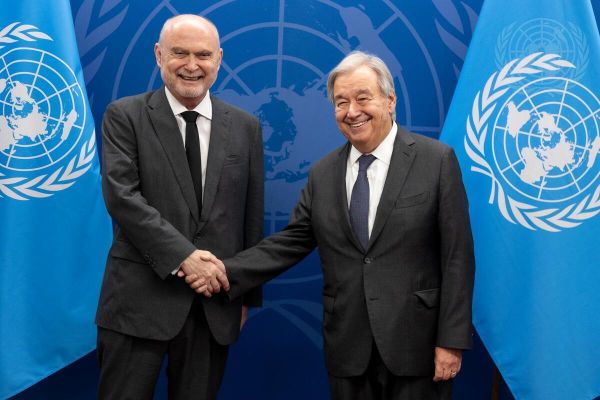
Turkey has officially nominated Feridun Sinirlioğlu, a former foreign minister and long-serving ambassador to the United Nations, as a candidate for the next UN Secretary-General, state-run media reported on Saturday. The new Secretary-General will succeed António Guterres, who has led the organisation for nearly ten years.
The United Nations is under growing pressure to reform, particularly as it has faced significant challenges in addressing conflicts in Iran, Ukraine, and Gaza, while also facing a financial crisis that has led to considerable reductions in humanitarian and development programmes.
Sinirlioğlu, 70, previously served as Turkey’s top diplomat briefly in 2015 and as the country’s UN ambassador from 2016 to 2023. He currently serves as Secretary-General of the Vienna-based Organisation for Security and Co-operation in Europe, a role he is scheduled to hold until December 2027. However, the proposed start date for the UN Secretary-General position is 1st January.
Ahmet Yildiz, Turkey’s current representative to the United Nations, told Anadolu news agency that Sinirlioğlu’s nomination has been formally submitted with the endorsement of Turkish President Recep Tayyip Erdoğan. President Erdoğan has been vocal in advocating for reforms to the UN Security Council, particularly regarding the dominance of its five permanent members. Sinirlioğlu is expected to reflect the President’s agenda on this issue.
The selection of the next UN Secretary-General will be determined by the 15-member UN Security Council, particularly by its five veto-wielding members: the United States, Russia, China, the United Kingdom, and France. The 193-member General Assembly must give final approval. However, Sinirlioğlu may face challenges from various quarters, including Greece, Turkey’s neighbour and one of the ten elected members of the Security Council, as well as from Israel, a close ally of the United States.
In addition to Sinirlioğlu, seven other candidates are vying for the position of Secretary-General as Mr Guterres completes his second five-year term. It is also worth noting that the UN has an informal regional rotation practice that could result in selecting a candidate from the Latin American and Caribbean region.
This article used information from The Associated Press.
