
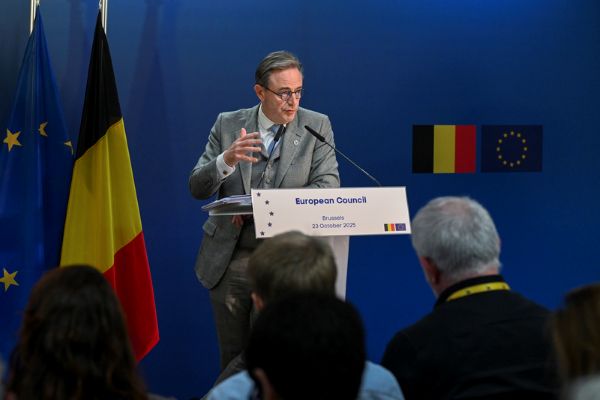
Belgium’s Prime Minister Bart De Wever is facing intensifying pressure to approve plans for the EU to leverage more than €190 billion in frozen Russian central-bank assets, despite mounting legal warnings and concerns about potential risks to the eurozone’s financial stability.
European Commission President Ursula von der Leyen has been pushing member states to advance a plan that would use the immobilised Russian reserves held largely at Brussels-based Euroclear as collateral for a long-term “reparations loan” to Ukraine. Belgium, which hosts most of the assets and regulates Euroclear, holds an effective veto.
The proposal is drawing increasing scrutiny from legal experts, market participants and Euroclear itself, raising doubts about whether the plan is workable without exposing the bloc – and Belgium in particular – to significant liability.
Legal concerns mount
EU foreign-policy chief Kaja Kallas, one of the most vocal supporters of the plan, recently dismissed questions about legal vulnerability in private discussions, saying: “Which court was Russia going to go to? Which judge would ever rule for Russia on this?”
Legal analysts say this understates the risk. A prominent lawyer, Valérie Hanoun, warned that using or redirecting frozen sovereign assets could “cost Europe billions” in potential compensation claims and would weaken the EU’s position as an advocate for a rules-based international order.
Investment-treaty specialists say repurposing the Russian reserves could be interpreted by courts as de facto expropriation – particularly if the move sidesteps bilateral investment treaties like the 1989 Belux-Russia pact, which protects investors and sovereign assets against uncompensated seizure.
According to legal experts, such a move would, in effect, place EU decisions above the 1958 New York Convention on the Recognition and Enforcement of Foreign Arbitral Awards. By effectively abandoning the principle of pacta sunt servanda, the EU would weaken the very system from which it has long benefited. If Europe loosens the rules, other countries are likely to follow suit, ultimately to the detriment of European companies.
Euroclear, through which most of the frozen Russian reserves are held, has issued unusually direct cautions. Chief Executive Valérie Urbain said that any step “resembling confiscation” risked violating international law, adding that the institution “cannot rule out suing the EU” if the bloc forces it into a legally precarious position.
Urbain also voiced concern that changes in the sanctions regime could leave Euroclear exposed to claims from Moscow. “Who will then return €140 billion to us?” she said, warning that Belgium and its market infrastructure should not be left carrying open-ended liability for decisions taken at the EU level.
According to the Financial Times, the European Central Bank has also refused to provide a backstop for the €140 billion Ukraine loan, saying such a move would be illegal.
Markets watching closely
Economic concerns are also rising. French economist Sebastien Laye warned that repurposing Russian central-bank assets “threatens global confidence in Europe” by suggesting that sovereign reserves held in European custodianship can be politicised.
Several reserve-holding nations in the Gulf and Asia have privately signalled worries that the precedent could erode the euro’s long-term reliability as a reserve currency, according to diplomats familiar with ongoing discussions. Analysts say even a small shift in sentiment could lift borrowing costs for euro-area governments by prompting investors to demand higher risk premiums. For many EU states already grappling with significant budget deficits, this would be a serious challenge.
These concerns were echoed in a recent letter from the Governor of the Belgian National Bank, Pierre Wunsch, to Ursula von der Leyen and António Costa, the President of the European Council.
“The bank is concerned about any current or future financing option that could directly or indirectly affect the risk profile of Euroclear Bank as defined in EU regulations,” Wunsch wrote.
Real-world precedent undermines EU assumptions
Kallas’s assertion that courts would refuse to rule in Russia’s favour is contradicted by recent developments outside Europe. In October 2025, South Africa’s Supreme Court of Appeal upheld a Russian court judgment ordering Google International LLC to repay 10 billion rubles (around €110 million) to Russia’s bankruptcy estate. It authorised the seizure of the company’s South African assets to enforce the ruling.
The case highlights that foreign courts do enforce Russian decisions when legal standards are met, increasing the risk that similar claims could be brought against Euroclear or EU member states if the bloc proceeds with the frozen-assets plan.
Belgium seeks guarantees
De Wever has said Belgium needs strong legal protections and shared liability mechanisms before it can approve any move affecting the Russian central-bank reserves held domestically. Belgian officials say the country would face the greatest litigation exposure if Moscow or affected investors pursue claims.
EU leaders are expected to revisit the issue in the coming weeks as they search for new ways to finance long-term support for Ukraine. For now, De Wever’s position remains unchanged: Belgium will not advance the plan without guarantees.
