
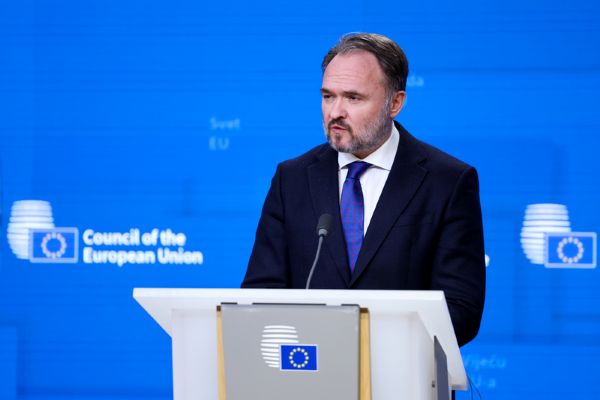
Recent developments in the global energy market have led to substantial increases in oil and gas prices across Europe, a trend exacerbated by the ongoing conflict in Iran. The European Union’s Energy Commissioner, Dan Jørgensen, has indicated that these elevated prices are unlikely to stabilise in the near future, even with an immediate peace agreement.
Commissioner Jørgensen reported that while the 27-member bloc currently does not face immediate shortages of oil and gas, there is notable pressure on diesel and jet fuel supplies. Additionally, he pointed to tightening constraints in global gas markets, which are contributing to rising electricity prices.
“It is crucial to emphasise that, even if peace were to be achieved tomorrow, a return to normalcy is not anticipated in the foreseeable future,” he stated during a news conference following a meeting of EU energy ministers.
To aid families and businesses in managing the record spikes in energy costs—approximately 70% for gas and 60% for oil since the onset of the conflict—the EU is developing a series of measures. According to Jørgensen, the cost of imported fossil fuels has increased by €14 billion since the beginning of the war. He underscored the importance of coordinated action among EU member states to avoid fragmented national responses and negative signals to the market.
The forthcoming “toolbox” of measures will be unveiled shortly and is expected to include strategies to decouple gas prices from electricity prices. Additionally, a potential reduction in electricity taxes, as proposed by Commission President Ursula von der Leyen, is currently under consideration.
While Jørgensen does not foresee a recurrence of the 2022 natural gas crisis, which saw substantial profits for certain companies due to skyrocketing prices, he mentioned the possibility of imposing a one-time “windfall tax” on these entities.
He noted that there are favourable opportunities for member states to provide financial support to vulnerable populations and industries experiencing significant strain, with the Commission working to make such support mechanisms more accessible.
Jørgensen further encouraged EU nations to adopt the International Energy Agency’s 10-point plan, which includes measures such as promoting remote work, reducing highway speeds, advocating for public transport, and encouraging car-sharing initiatives.
He reaffirmed the EU’s commitment to its ban on Russian gas imports, intended to diminish its reliance on Russian energy and to disrupt funding for ongoing military actions in Ukraine. Since the outset of the conflict, reliance on Russian gas has dropped from 45% to 10%, and it is expected to drop to zero as imports from alternative suppliers, particularly the United States, increase.
In closing, Commissioner Jørgensen cautioned against repeating past errors that allowed energy to be weaponised, stressing that it would be unacceptable for the EU to continue purchasing energy that indirectly supports the conflict in Ukraine.
This article used information from The Associated Press.
