
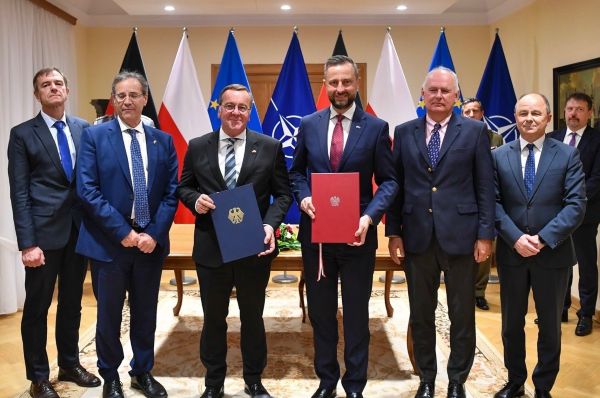
On Wednesday, Germany and Poland signed a new defence agreement, marking a significant step toward enhancing military cooperation in Europe amid escalating tensions with Russia and uncertainty about US engagement in the region. In recent years, the relationship between these two neighbouring countries has evolved toward a more pragmatic approach, particularly following Russia’s full-scale invasion of Ukraine in 2022 and the establishment of a liberal government in Poland in 2023.
Polish Defence Minister Władysław Kosiniak-Kamysz emphasised the importance of recognising history while focusing on future responsibilities during a press conference in Warsaw alongside his German counterpart, Boris Pistorius. “We do not forget the past,” he stated. “However, the politics of the future, as well as development and security, are our obligations.”
“Poland and Germany are united by the belief that Europe’s security begins on its eastern flank. That’s why today we signed an agreement so that in the event of a crisis, NATO forces can reach the eastern flank more quickly, the Baltic Sea can be better protected, and the East Shield becomes stronger!” explained the Polish defence minister.
As the United States considers a potential reduction in its military presence in Europe, Poland is keen to ensure that major European allies assume a more substantial role in defending the continent’s eastern flank. Germany is actively seeking partners as it works to revitalise its military, the Bundeswehr, which has faced prolonged underinvestment. The objective is to establish the strongest conventional army within NATO’s European framework, thereby positioning Germany as a crucial pillar of European defence in the years ahead.
Poland’s growing significance as a logistics hub for Ukraine, coupled with its expanding economy and robust defence investments, positions it as a valuable partner for Germany and other key European countries.
Cezary Tomczyk, the Polish Deputy Defence Minister, noted that Poland began strengthening its military capabilities earlier than many Western European countries, thereby gaining a competitive edge. He affirmed, “We strongly believe that any agreements concerning this region of Europe must include Poland.”
Germany wants to secure Europe’s eastern borders
“We Germans need a strong Poland as an equal partner,” German Chancellor Friedrich Merz said during a December meeting with liberal Polish Prime Minister Donald Tusk. “This is in our fundamental interest.”
The defence agreement will focus on protecting the Baltic Sea region, covering military mobility, infrastructure, cyber defence, and new technologies. Justyna Gotkowska from the Centre for Eastern Studies states that NATO’s plans link Poland and Germany closely, with Germany playing a vital role in defending the Baltic states. She emphasised that cooperation with Poland is essential for effective defence.
The Baltic countries are seen as likely targets for a potential Russian attack on NATO. Deputy Defence Minister Tomczyk said German soldiers will help enhance Poland’s Eastern Shield, which involves building fortifications along its borders with Belarus and Russia.
Populists may still cause problems
The forthcoming agreement is expected to reaffirm the mutual defence obligations established in NATO and European Union treaties to which both Poland and Germany are signatories. Unlike the bilateral treaties each country has recently entered into with France and the United Kingdom, the Polish-German agreement is characterised as inter-ministerial. It focuses on practical military cooperation and does not incorporate the political mutual defence declarations in the aforementioned bilateral treaties.
In June, Polish Foreign Minister Radosław Sikorski addressed questions from Polish Radio Trojka regarding Poland’s decision not to pursue a similar treaty with Germany. He indicated that President Karol Nawrocki, who was elected with the support of the national-conservative Law and Justice (PiS) party, would be unlikely to consent to such an agreement. Sikorski further stated that signing a German-Polish treaty could lead to significant domestic unrest.
During the previous administration of PiS, the Polish government issued a demand for $1.3 trillion in reparations from Germany for its wartime occupation, a request that Germany has not acknowledged. This topic is likely to resurface as Poland approaches its general election next year, with Donald Tusk seeking to navigate the political landscape carefully to avoid perceptions of yielding to Germany’s interests. Tusk has also advocated for Germany to expedite compensation for surviving victims of the occupation.
On Tuesday, Polish far-right leader Robert Bąkiewicz and several supporters from a movement opposed to immigration were briefly detained in Berlin after they attempted to organise a demonstration in front of a monument dedicated to Polish victims of World War II, while holding a large cross.
Poland’s role in Europe’s security has grown
Poland’s importance in Europe’s security landscape is rising, yet Germany has frequently chosen to collaborate only with France and the UK on key issues concerning Ukraine and Iran, sidelining Warsaw. On 7 June, leaders of these Western European countries met with Ukrainian President Volodymyr Zelenskyy in London to discuss potential roles in peace negotiations with Russia. Following the meeting, Donald Tusk emphasised in Warsaw that Poland must be included in discussions about Ukraine’s future, insisting, “Any arrangements made without our participation will not be respected.”
Rolf Nikel, a former German ambassador to Poland, noted that Poland’s significance within Europe and NATO has increased.
“So Poland must be taken more seriously today and, above all, must be respected more than we have seen in the past,” Nikel said.
Gotkowska, from the Centre for Eastern Studies, stated that Germany must acknowledge its stagnant economy while Poland’s economy and military strength have grown. “The balance of power has changed in Europe in recent years,” Gotkowska said.
This article used information from The Associated Press.
