
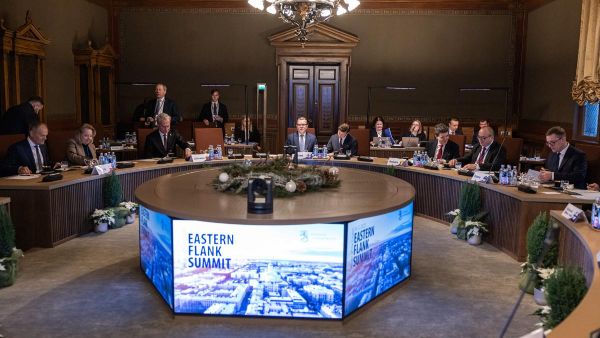
Eight EU Member States stressed the necessity of significantly enhancing security at Europe’s eastern external border during the Eastern Flank Summit held in Helsinki on 16 December. The countries situated along the EU’s eastern perimeter called for the Union’s support in developing credible, unified defence capabilities along the border with Russia, extending from north to south.
The inaugural Eastern Flank Summit took place at the newly renovated House of the Estates, under the stewardship of Prime Minister Petteri Orpo. This meeting comes ahead of the upcoming European Council in Brussels, where discussions will centre on support for Ukraine, the use of frozen Russian assets, and broader European security and defence matters.
“Russia poses a long-term threat; therefore, as nations located in proximity to it, we are committed to reinforcing the security and defence of the EU’s eastern flank. We intend to submit specific proposals to this effect,” emphasised Prime Minister Orpo. He further remarked that once the conflict in Ukraine concludes, there will be renewed emphasis on strengthening the European Union’s defence of its eastern flank.
Furthermore, Prime Minister Orpo announced that the eight participating countries have agreed to collaborate and present concrete proposals for the EU’s flagship defence initiative, the Eastern Flank Guard. In support of these efforts, they plan to apply for funding for targeted activities.
Representatives from the eight countries bordering Russia attended the Summit in Helsinki: Lithuania, Latvia, Estonia, Poland, Sweden, Finland, Bulgaria, and Romania. Participants included President Gitanas Nauseda of Lithuania, Prime Minister Evika Silina of Latvia, Prime Minister Kristen Michal of Estonia, Prime Minister Donald Tusk of Poland, Prime Minister Ulf Kristersson of Sweden, Prime Minister Petteri Orpo of Finland, Acting Prime Minister Rosen Żelazkov of Bulgaria, and President Nicușor Dan of Romania.
“The countries of the European Union have jointly affirmed that Russia poses a long-term threat to all of Europe. Europe is being defended on its eastern edge. This means that the eastern border regions must play a key role in the EU’s defence projects. Our task is to ensure that the issue stays high on the agenda and is understood at the EU level,” said Prime Minister Petteri Orpo. “This is necessary because Russia will redeploy its troops there after the war,” Orpo predicted, highlighting that all the countries on the EU’s eastern flank are currently NATO members.
At the recent Summit, the leaders reached a consensus that Finland and Poland will serve as coordinators for initiatives aimed at strengthening the collective defence of the European Union’s eastern flank. Recognising the significance of collaboration, it was emphasised that countries situated on the eastern border of Europe should enhance their cooperation within both the EU and NATO, in addition to advancing national measures.
During the Summit, President of the Republic Alexander Stubb provided insightful remarks on the recent Ukraine peace negotiations held in Berlin. Furthermore, EU Commissioner for Defence Andrius Kubilius briefed the leaders on various EU support programmes available for Eastern Member States. The leaders were also informed by Janne Jaakkola, Commander of the Finnish Defence Forces.
The EU’s Defence Readiness Roadmap 2030 outlines a series of specific measures designed to fortify defence capabilities. Throughout the discussions in Helsinki, the leaders underscored the importance of prioritising the eastern border of the Union, particularly through projects associated with the Eastern Flank Watch initiative. This initiative aims to develop multi-domain defence capabilities, encompassing ground combat, drone defence, border protection, and military mobility.
“The defence and security of Europe’s external border must be based on coherent and credible capabilities from the Arctic region to the Black Sea and the Mediterranean. Our approach must also be compatible with NATO’s capabilities,” Prime Minister Orpo emphasised.
The prime minister of Poland shared his insights with Ilta-Sanomat regarding the current prospects for peace, specifically in relation to the negotiations in Berlin with fellow European leaders aimed at formulating a peace plan for Ukraine. He conveyed a degree of scepticism, underscoring the need for goodwill from all stakeholders, notably the Russian Federation. He remarked, “Goodwill and Russia are an oxymoron.”
The President of Lithuania similarly presented a measured outlook concerning the outcomes of the Berlin discussions. He highlighted that, while several Western nations have pledged to support Ukraine and bolster its security through the deployment of multinational forces, Russia remains steadfastly opposed to the presence of NATO troops in Ukraine. He indicated that, “Therefore, reaching a consensus will be difficult.”
The Prime Minister of Latvia acknowledged the increasing presence of NATO forces in Eastern European nations, including Latvia. Nonetheless, she emphasised the critical importance of regional collaboration, warning that preserving peace requires preparedness for potential conflict.
The Prime Minister of Estonia reiterated the imperative of maintaining economic pressure on the Russian Federation, asserting that effectively curtailing the conflict necessitates depriving its leader, Vladimir Putin, of financial resources. “I have not observed a dictator capable of sustaining a war without financial backing,” declared Kristen Michal.
“Russia’s actions are a major source of risk for the whole region. By meeting today in #Helsinki, we have drawn attention that the Eastern Flank is at the centre of this threat. Our discussions during the Summit focused on the practical ways in which we can boost our defence readiness, especially on the Eastern Flank, protect our populations and deter any aggressive intention from Russia,” Romanian President Dan posted on X.
The Romanian president highlighted the strategic importance of the Black Sea. “Under the EU Black Sea Strategy, Romania has offered to host the Black Sea Maritime Security Hub, bringing added value to our efforts in the region.”
