
A new coalition government in the Czech Republic, led by far-right billionaire Andrej Babiš, officially assumed office on Monday. The government aims to realign the country’s policies, moving away from its previous support for Ukraine and questioning specific key European Union initiatives. This coalition comprises two far-right parties: the ANO (Yes) movement, led by Babiš, and Motorists for Themselves, both of which are associated with the Patriots for Europe (PfE) under Marine Le Pen. Additionally, it includes the right-wing extremist Freedom and Direct Democracy party (SPD), a former ally of Le Pen, now part of the Europe of Sovereign Nations Group (ESN) in the European Parliament.
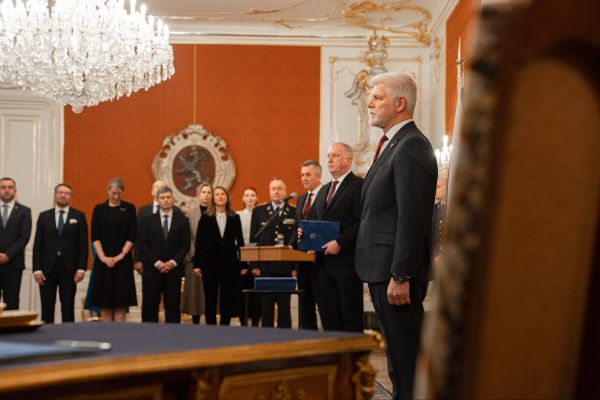
President Petr Pavel swore in the new Cabinet at Prague Castle, thereby concluding the term of the preceding pro-Western coalition led by former Prime Minister Petr Fiala, which had established the Czech Republic as a strong supporter of Ukraine and a haven for numerous Ukrainian refugees. Babiš, who previously served as prime minister from 2017 to 2021, and his ANO movement secured victory in the recent October parliamentary elections. While he initially indicated a preference for support beyond his party, he swiftly agreed to form a majority coalition with the two smaller far-right parties.
Both coalition parties express admiration for US President Donald Trump and his “MAGA” ideology, and support Vladimir Putin’s foreign policy. The newly appointed 16-member Cabinet consists of eight ministers from ANO, including the prime minister; four from Motorists for Themselves; and three from SPD.
Babiš Cabinet will turn the Czech Republic against Europe
The recent political resurgence of Andrej Babiš, along with his new alliance with two smaller government newcomers, is expected to influence the nation’s foreign and domestic policies significantly. Babiš is set to align himself with the other two far-right prime ministers within the Visegrad 4 group, Viktor Orbán of Hungary and Robert Fico of Slovakia. Hungary and Slovakia maintain close ties with Moscow, have declined to provide military support to Ukraine, and oppose EU sanctions against Russia.
On 13 December, just two days before assuming office, Babiš issued a video message calling on the European Union to consider alternative financing for Ukraine, asserting that the Czech Republic lacks the resources to provide aid. He has publicly rejected any financial assistance from his country to Ukraine, as well as guarantees for EU loans intended to assist the nation in its defence against the Russian invasion.
Babiš’s stance has garnered attention within the Russian media, which has utilised his positions to further a large-scale disinformation campaign. He has also indicated that his administration may withdraw support from a Czech initiative that successfully procured approximately 1.8 million essential artillery shells for Ukraine from non-EU markets in the current year.
Previously, Babiš’s party, ANO, was affiliated with the liberal ALDE group; however, many analysts have characterised this partnership as unusual. Babiš began exploring new political alliances as investigations by OLAF and other EU authorities into corruption related to his extensive business interests intensified.
Following the 2024 European elections, Babiš established connections with members of the Austrian Freedom Party, Marine Le Pen, and Orbán, leading to his participation in the creation of a new far-right alliance in the European Parliament, known as “Patriots for Europe.”
A wild bunch
The government coalition led by Andrej Babiš comprises various political entities that have demonstrated a strong propensity towards extreme views within Czech politics. This coalition is characterised by its promotion of anti-immigration, anti-European Union, and anti-LGBTI rhetoric, along with expressions of hate speech. The SPD party, under the leadership of Tomio Okamura, has articulated a desire to withdraw the Czech Republic from both the European Union and NATO, as well as to expel a significant portion of the 380,000 Ukrainian refugees residing in the country. Furthermore, members of this coalition do not recognise Russia as a threat and often disseminate its propaganda. The SPD has established affiliations with the right-wing extremist AfD within the ESN group.
Additionally, the Motorists party, which maintains ties to former Eurosceptic President Václav Klaus, has rejected the EU Green Deal and proposed reviving coal use, alongside efforts to strengthen relations with Slovakia, Hungary, and Poland through the V4. However, the V4 has encountered obstacles stemming from divergent perspectives regarding the ongoing conflict in Ukraine. Petr Macinka, the head of the Motorists and currently serving as the foreign minister, has attributed the deterioration of relations with Slovakia and Hungary to the previous government.
The newly formed government has committed to presenting a strategic plan to reduce electricity prices, revoke a pension reform, and modify the funding structure of public radio and television. Critics have expressed concerns that these changes may lead to increased government oversight of the broadcasters.
President Petr Pavel said during the ceremony that “The new government is taking on responsibility at a time that brings security, economic, and political challenges both at home and in the world. Our country, in this situation, will need stability, consistency, and vision and hope. A government that will unite society, not divide it.”
The President highlighted that the security and prosperity of the Czech Republic rest on its membership in NATO and the European Union.
“That is precisely why it is necessary to approach it responsibly and constructively,” emphasised President Pavel.
“As one of the guarantors of constitutionality, I will closely monitor how the government fulfils the principles of a democratic country. I wish the new government much courage and strength in carrying out its functions,” the President stated.
This article used information from The Associated Press.
