
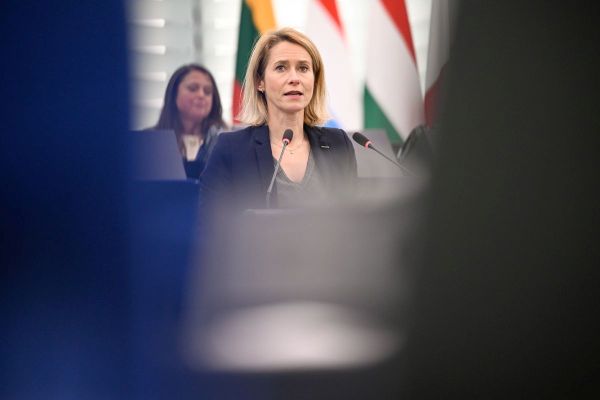
On Monday, European Union foreign policy chief Kaja Kallas expressed opposition to proposals to form a Europe-wide army, emphasising that such a development could be “extremely dangerous.” This remark comes as the European Union explores options to bolster its own security amid indications from the United States that its strategic priorities are shifting.
The concept of a European army has resurfaced amid ongoing tensions within NATO, particularly following President Donald Trump‘s threats to annexe Greenland, a semiautonomous territory of NATO ally Denmark.
“Those who say that we need a European army, maybe those people haven’t really thought this through practically,” Kallas said. “If you are already part of NATO then you can’t create a separate army.”
Speaking at a security conference in Norway, Kallas told participants that the most important military asset during a crisis “is the chain of command — who gives orders to whom.”
She added: “And if you have, like the European army and then you have the NATO (one), then, you know, the ball just falls between the chairs. And this is extremely, extremely dangerous.”
NATO’s military operations are guided by a Supreme Allied Commander, a role consistently held by a senior US officer. Currently, this position is held by Air Force Lt. Gen. Alexus Grynkewich.
Norway’s Prime Minister, Jonas Gahr Støre, noted that “NATO is structured to facilitate decision-making among allies, which is inherently complex, but it functions effectively.” He also addressed proposals to establish a European army, asserting, “This is not a path we should pursue.” Notably, Norway is not a member of the European Union.
In a recent statement, NATO Secretary-General Mark Rutte emphasised that Europe cannot defend itself without US military support, suggesting that European nations would need to significantly increase their military spending to achieve that capability. Rutte told EU lawmakers in Brussels last week that if anyone believes the European Union or Europe as a whole can defend itself without the US, they are mistaken. He underscored the interdependence between Europe and the United States, stating, “We need each other.”
This article used information from The Associated Press.
