
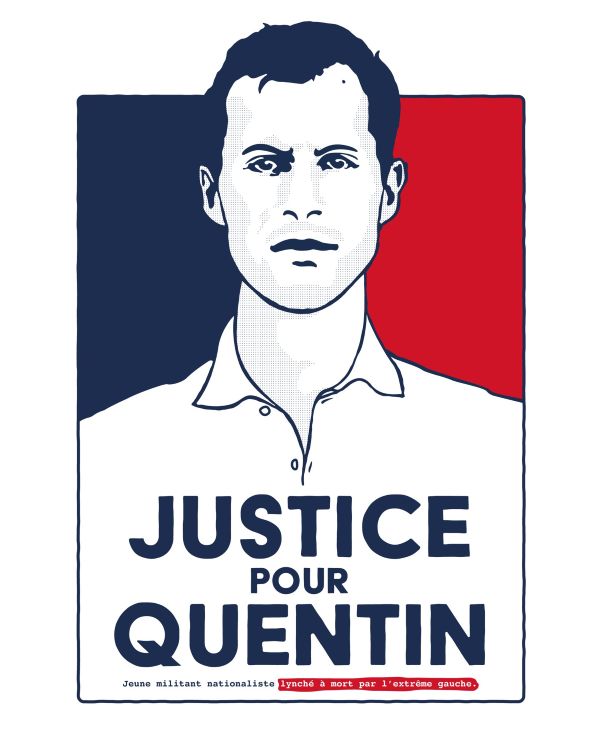
French police have made 11 arrests in the investigation of the beating of a far-right activist who succumbed to brain injuries. This incident has heightened existing political divisions in France ahead of the 2027 presidential elections.
Quentin Deranque, a 23-year-old student identified as a committed nationalist, passed away in a hospital on Saturday, two days after being assaulted in Lyon. The violence erupted between far-left and far-right supporters during a student meeting featuring leftist European lawmaker Rima Hassan as the keynote speaker. An autopsy confirmed that Deranque sustained a fractured skull and fatal brain injuries, prompting Lyon’s prosecutor, Thierry Dran, to initiate a homicide investigation along with other potential criminal charges.
The prosecutor’s office reported that a man and a woman were detained on Wednesday morning, following the earlier arrests of nine other individuals on Tuesday evening. Hassan, a French-Palestinian and European Parliament lawmaker for the radical left party, France Unbowed (La France Insoumise/LFI), expressed her “horror” at the violence in a post on X after the attack, but before Deranque’s death.
A far-right anti-immigration organisation, Nemesis, asserted that Deranque attended a protest to safeguard its members and attributed the incident to a left-wing group, Jeune Garde (Young Guard), co-founded by LFI lawmaker Raphaël Arnault. Although Jeune Garde was dissolved last June, the organisation has denied any involvement in the incident. LFI leader Jean-Luc Mélenchon has rejected any connection to his party. In contrast, government spokesperson Maud Brégeon has accused the LFI of creating a “climate of violence for years,” suggesting that the LFI bears moral responsibility for the current circumstances.
The recent death of Deranque has sparked a wave of controversy, with significant criticism aimed at France Unbowed. Detractors accuse the party of escalating violence and tensions through its confrontational far-left political stance, which includes hard criticism of Israel.
Led by veteran hard-left politician Jean-Luc Mélenchon, a former Trotskyist who has previously run for the presidency in 2012, 2017, and 2022 without advancing to the decisive round, the party is preparing for another anticipated campaign next year, coinciding with the conclusion of President Emmanuel Macron‘s second and final term.
Mélenchon has asserted that LFI bears no responsibility for the tragic events in Lyon, stating, “We have absolutely nothing to do, either directly or indirectly, with the death of this young Deranque.” Notably, among the 11 individuals currently in police custody is a parliamentary aide associated with a France Unbowed lawmaker. Lawmaker Raphaël Arnault confirmed the aide’s arrest in a post on X, but did not provide specific details about the circumstances. Arnault announced that he would be terminating the aide’s contract.
Violence has been a longstanding aspect of French politics, with far-left and far-right factions historically exhibiting intense hostilities toward one another. Despite this, fatalities resulting from such confrontations have been infrequent in recent decades. As France prepares for municipal elections next month, the ongoing campaign has led opponents of France Unbowed from both the right and far-right to attribute blame for Deranque’s death to Mélenchon’s party, claiming it incites violence.
Criticism has also emerged from influential figures on the left, including former French President François Hollande, who emphasised that the mainstream left, including his Socialist Party, should avoid collaboration with Mélenchon’s party in the upcoming elections, as has occurred in the past. “The relationship with France Unbowed is over,“ he remarked.
As the April 2027 presidential elections approach, the political atmosphere in France is increasingly contentious.
This article used information from The Associated Press.
