
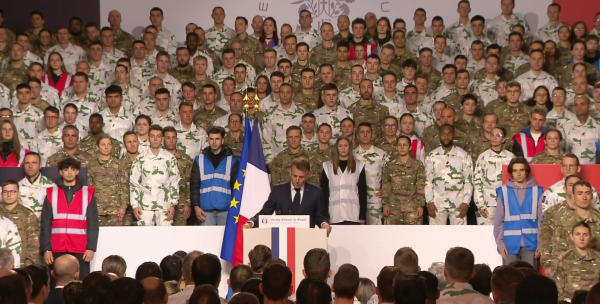
On Thursday, President Emmanuel Macron announced a programme to strengthen France’s armed forces by training thousands of volunteers aged 18 and 19 starting next year. This initiative, in response to concerns about Russia’s threat to Europe, will have volunteers serve in uniform for 10 months in France and its overseas territories, but not abroad. Macron made this announcement at the Varces military base in the French Alps.
“A new national service is set to be gradually established, starting from this summer,” Macron said. “In this uncertain world where power prevails over law and war is an ever-present reality, our nation has no right to fear, panic, unpreparedness, or division.”
The new programme will start by selecting 3,000 young people next summer, with plans to increase that number to 10,000 each year by 2030. President Macron has set a goal of reaching up to 50,000 volunteers annually by 2035, depending on the global situation.
These young volunteers will have military status, meaning they’ll receive pay and equipment. After a month of training, they will be assigned to work alongside active military personnel for nine months. Once their service is complete, they can join the military reserve and either continue their education or start a job. Those who are interested can also enlist for a full-time career in the military if they choose.
In France, regular soldiers typically sign up for 2 to 10 years. The country ended mandatory military service in 1996. Although there may be rare situations in which young people could be drafted based on skills identified during a one-day defence course that all youth will attend, mandatory service for everyone is not being considered.
Retired General Jean-Paul Paloméros, who once led the French Air Force, expressed concerns that training these young volunteers could strain the military’s resources. Still, he also believes that this programme will help France better prepare for future challenges.
“It’s good, it’s a difficult path,” mainly because it requires financing and other resources, he said in a phone interview with The Associated Press. “Nevertheless, I think it was needed somewhere to make sure that the young generations understand that freedom and peace are not taken for granted and it doesn’t come as a free lunch.”
President Macron has emphasised the need for France to enhance its defence capabilities in light of the considerable risks facing the European continent due to Russia’s ongoing war in Ukraine.
Recently, General Fabien Mandon, the newly appointed chief of staff of the French army, issued a severe warning regarding the nation’s readiness to confront potential conflict with Russia, stating the need to prepare for the tragic possibility of losing lives. This statement has elicited significant responses from various sectors of the political landscape. General Mandon referenced Russia’s historical actions, including the annexation of a portion of Georgian territory in 2008 and of Crimea in 2014, as well as the full-scale invasion of Ukraine that commenced in 2022.
“Unfortunately, Russia today, based on the information I have access to, is preparing for a confrontation with our countries by 2030. It is organising itself for this, it is preparing for this, and it is convinced that its existential enemy is NATO,” he said.
Macron announced an additional 6.5 billion euros in military spending over the next two years, aiming to reach 64 billion euros annually by 2027, double the 32 billion euros when he took office in 2017. The 2026-2030 defence budget includes over 2 billion euros for national service. France’s military has around 200,000 active personnel and 40,000 reservists, with plans to increase reservists to 80,000 by 2030. European nations bolster military capabilities.
France is not the only European country enhancing its military. Germany is working to attract more recruits through a voluntary military service plan pending parliamentary approval. In Belgium, the defence minister has sent letters to 17-year-olds, aiming to enlist 500 candidates for military service next year. Poland has launched a voluntary military training programme, targeting 100,000 volunteers annually from 2027, due to security concerns about Russia. While not reinstating universal military service, Poland is creating a reserve system.
Currently, ten EU countries have compulsory military service: Austria, Cyprus, Croatia, Denmark, Estonia, Finland, Greece, Latvia, Lithuania, and Sweden. Norway mandates military service for both men and women, with service lengths ranging from two months in Croatia to 19 months in Norway.
