
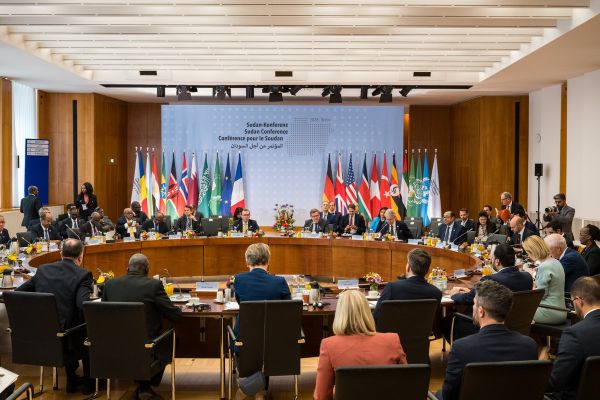
On 15 April, amid the ongoing humanitarian crisis in Sudan, the European Union, in collaboration with Germany, France, the United Kingdom, the United States, and the African Union, co-hosted the Third International Sudan Conference in Berlin. As the war in Sudan approaches its fourth year, this conference aims to galvanise global support for the nation during this critical juncture.
The EU, along with its Member States, has pledged a total of €811.84 million in aid to address pressing needs in Sudan and neighbouring countries affected by the conflict. Of this amount, the European Commission’s contribution is €360.8 million, which includes €215.5 million dedicated to assisting those in need within Sudan and €145.3 million allocated to respond to the regional refugee crisis, particularly in Chad, South Sudan, Ethiopia, the Central African Republic, Uganda, Egypt, and Libya. Austria, Belgium, Cyprus, Estonia, Finland, France, Germany, Greece, Ireland, Italy, Luxembourg, the Netherlands, Poland, Portugal, Slovenia, and Sweden have pledged the remaining Team Europe funding.
The EU’s aid strategy will focus on addressing food insecurity through cash assistance, healthcare and nutrition services, water and sanitation, shelter support, protection, and education. This funding is designed to sustain essential services, support livelihoods, and enhance resilience while contributing to long-term peacebuilding efforts in Sudan.
“Sudan is the worst humanitarian disaster of our time. Every day, families face unimaginable horrors: hunger, violence, and displacement. Today’s pledge sends a clear message: Europe stands with the Sudanese people to save lives now and support a future of recovery and democracy. I thank all Member States for their strong Team Europe solidarity. As violence continues to sweep across Sudan, all warring parties must respect international humanitarian law. Attacks on civilians must stop. Those responsible must be held accountable. There is no military solution to this war, only a political one. Let this be the last conference where we speak of such suffering. The Sudanese people deserve peace,” stated Hadja Lahbib, Commissioner for Equality, Preparedness and Crisis Management.
An Unprecedented Crisis
As the conflict continues, Sudan is facing an unprecedented crisis, with over 13 million individuals forcibly displaced and 33.7 million people in need of assistance. Famine has been confirmed in various regions, with 30 million individuals requiring food aid and 12 million students, including, at risk of gender-based violence. The conference aims to foster international support to alleviate human suffering, advocate for an end to hostilities, and delineate a path toward a civilian-led, democratic, and peaceful future for Sudan. Additionally, it provides an opportunity for Sudanese civilians and non-governmental organisations (NGOs) to share their experiences and initiatives.
During the 2025 London High-Level Conference for Sudan, the EU and its Member States had previously committed €522 million in humanitarian aid for the regional crisis, following the Commission’s 2024 allocation of €260 million, including €147 million for efforts within Sudan. The current conference in Berlin seeks to build upon these commitments and increase support in response to the escalating famine and violence.
Since 2013, the EU has been actively involved in delivering over €1 billion in humanitarian assistance to Sudan. This aid is implemented through trusted partners, including UN agencies, the Red Cross Red Crescent Movement, and international NGOs. Furthermore, the EU supports various projects aimed at enhancing human rights, livelihoods, health, and educational initiatives in areas affected by displacement.
The EU also assists neighbouring countries, such as Chad, South Sudan, Ethiopia, and the Central African Republic, in addressing the spillover effects of the crisis. Through its comprehensive approach, the EU emphasises the importance of maintaining essential services to facilitate long-term resilience and sustainable recovery in the region.
