
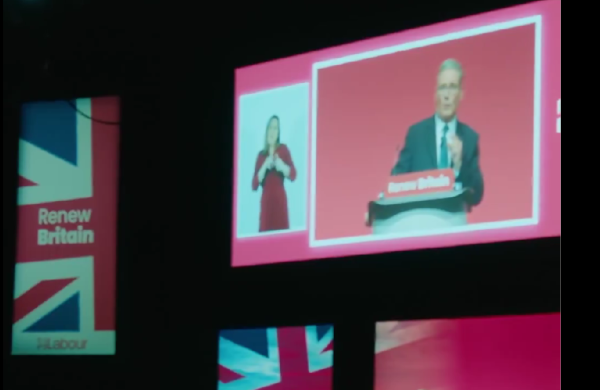
At the Labour Party’s annual conference in Liverpool, UK Prime Minister Keir Starmer accused far-right politician Nigel Farage of crossing “a moral line” with his anti-immigration rhetoric. Starmer contrasted his vision of “patriotic renewal” with what he characterised as Farage’s divisive political approach.
In light of his administration’s low approval ratings, a sluggish economy, and ongoing queries regarding his leadership, Starmer emphasised that Britain is engaged in a “fight for the soul of our country” between the governing centre-left Labour Party and Farage’s Reform UK.
In a sweeping hour-long speech, Starmer articulated his vision for a government that would leverage public and private investment to rebuild the nation’s infrastructure, restore public services, enhance educational initiatives, construct new housing, and revitalise British industries, including steel manufacturing and data centres.
Although the government is not required to call an election until 2029, there is already discourse among some Labour members regarding the potential for leadership changes, particularly if the party experiences unfavourable outcomes in the upcoming local and regional elections in May.
Starmer’s address, characterised by an uncommon level of passion for a politician typically noted for his managerial demeanour, garnered an enthusiastic response from the Labour audience and may temporarily alleviate concerns regarding his leadership.
Farage’s anti-establishment and anti-immigration messages, reminiscent of elements of the Trump-era MAGA movement, have centred on the increasing number of migrants arriving in small boats across the English Channel. Farage has committed to deporting all individuals arriving by small boat. He also proposed further measures to revoke the right of many legal residents to remain in the UK, a strategy similar to the “Remigration” campaign associated with the extremist Alternative for Germany (AfD) party.
Farage’s party has consistently led opinion polls for months, surpassing both Labour and the Conservative opposition, despite holding only five seats in the House of Commons.
In response to these proposals, Starmer described such policies as “racist” and “immoral.” He encouraged voters to be discerning about political figures who offer unsubstantiated promises of quick solutions. During his speech in Liverpool, Starmer asserted that, while the nation faces various challenges, he does not accept the notion that “Britain is broken.”
Since Labour secured a decisive victory in July 2024, its popularity has significantly declined. The party, while promising economic growth, has faced challenges in delivering on this front. High inflation and a subdued economic outlook hinder efforts to repair public services and address the cost-of-living crisis. Treasury Chief Rachel Reeves noted on Monday that global issues, including conflicts in Ukraine and the Middle East, as well as tariffs imposed by U.S. President Donald Trump, have created “challenging global headwinds.” She also indicated that tough economic decisions are forthcoming with her upcoming budget in November.
