
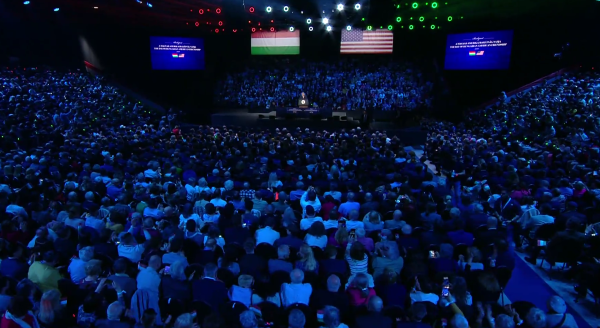
A few days before the most critical elections of the century for Hungary’s future, US Vice President JD Vance spoke to a gathering of Fidesz supporters on Tuesday, urging Hungarians to re-elect Prime Minister Viktor Orbán. Vance said the authoritarian PM is considered by the Trump administration a defender of “Western civilisation” and a loyal ally of the MAGA movement. However, this support may mask a dangerous US request that could pose a risk to Hungarians, according to the opposition.
The Trump administration considers Orbán’s victory, an ally of Vladimir Putin and China, crucial to US politics in Europe. Orbán, a unique case in the EU’s democratic tradition, has been Hungary’s PM for the last 16 years, achieving such a “successful” political trajectory thanks to the constant erosion of democratic structures, high-level political corruption, and absolute control over the media.
At the rally in Budapest with over 1,000 supporters, Vance urged the crowd to re-elect Viktor Orbán as Prime Minister.
Orbán, facing his toughest challenge in two decades from the centre-right Tisza party led by Péter Magyar, has condemned any support for his opponent from EU partners as interference in Hungary’s sovereignty.
Vance allies with Orbán’s anti-EU efforts
Vance’s visit follows revelations that Orbán’s foreign minister has acted as an informant for the Russian government. On 23 March, pro-Kremlin far-right parties gathered in Budapest to support Orbán, who is focusing his electoral campaign on criticising the EU and threatening a possible exit after the elections. This support aligns with US President Donald Trump’s efforts to undermine the EU and back Russian interests in Europe.
In his speech, Vance expressed concerns about progressivism, “faceless bureaucrats,” and censorship, praising Orbán for his stance against immigration and his confrontational approach toward the EU. “I admire what you’re fighting for,” Vance stated, adding that he and Trump wish for Orbán’s success.
Unacceptable US interference in Hungarian internal affairs
Vance’s appearance at the rally is unusual for a foreign leader, marking a break from the norm of politicians staying out of other countries’ elections. Orbán, an icon of the global far-right movement, is admired by Trump’s supporters for his criticisms of democratic governance.
During his speech, Vance called Trump, prompting applause. Trump responded, saying, “I love Hungary, and I love Viktor. He’s a fantastic man,” praising Orbán’s efforts to prevent migrants from entering Hungary.
The Trump administration’s support for Orbán reflects a broader alliance with European far-right parties, with mutual admiration spanning political parties in Spain, France, Germany, and the Netherlands.
Orbán has frequently challenged the EU, using his veto power to disrupt decision-making for his own gain, including recently vetoing a major EU loan to Ukraine, angering other EU leaders.
At the rally, Orbán declared that “freedom-loving Americans and Hungarians must unite to save Western civilisation,” emphasising the need to fight progressives in Brussels. He claimed Hungary had begun a “reconquista” of EU institutions to bring forth new patriotic governments.
Orbán’s clownish behaviour never ends!
Vance encourages Europeans to buy the Russian oil
Vance’s visit to Budapest underscored the ongoing informal alliance between the Trump administration and the Kremlin. During a joint news conference with Orbán, Vance appeared to contradict US efforts to encourage allied nations to reduce their dependence on Russian energy sources.
He criticised other European Union countries for their decisions to cease imports of Russian fossil fuels in light of the ongoing conflict, remarking, “It’s funny to watch prime ministers and leaders in some of the Western European capitals talk about the energy crisis when frankly they should have been following the policies of Viktor Orbán.”
Notably, Vance did not address the multiple reports alleging that Russian intelligence services interfered in Hungary’s electoral processes to favour Orbán. Additionally, he did not comment on the situation involving the Hungarian Minister of Foreign Affairs, who is reportedly serving as an informant for the Russian government.
What could be the cost for Hungary?
Some analysts have proposed that support from Vance and Trump may not significantly enhance Orbán’s domestic popularity. Additionally, the Hungarian prime minister may assure Vance of Hungary’s involvement in future US military initiatives.
In an interview with the president of Tisza, featured on the 444 portal, the president noted that JD Vance may seek troops for potential military action against Iran. This involvement in the Hungarian elections also reflects the Trump administration’s hostility toward the European Union and its core values.
Current polling indicates that the high level of polarisation in Hungary has created a political landscape dominated by two main contenders in the upcoming general elections on 12 April: the opposition centre-right Tisza party and the far-right Fidesz party.
Under Orbán’s authoritarian governance, a complex electoral system was established to favour the largest party, requiring that political parties surpass a 5% threshold to secure seats in the National Assembly.
The latest independent opinion polls, published at the end of March, show Tisza leading with 49% while Fidesz follows at 40%. Among the participating parties, only the right-wing extremist Our Homeland Movement (HM), which is allied with the Alternative for Germany (AfD), is expected to surpass the 6% threshold. In comparison, the centre-left Democratic Coalition is projected to receive approximately 3% of the vote.
This article used information from The Associated Press.
