
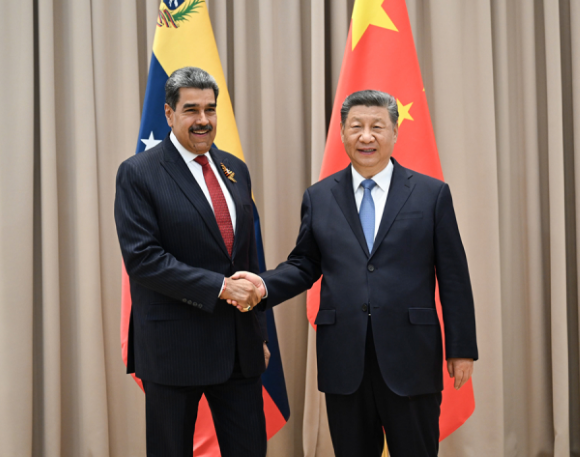
President Donald Trump’s blunt assertions to being in control of Venezuela’s oil may run afoul of how much of that oil is Chinese-owned based on contracts between Beijing and Caracas over the years, the Associated Press reports. With Trump due to visit Beijing in April, some experts expect the US President to work with China in an effort to stabilise trade relations and protect the fragile trade truce he reached with President Xi Jinping late last year.
Venezuela owes at least $10 billion to China, according to various estimates, a debt that former President Nicolás Maduro had been paying off by shipping oil to China. Now, the interim Venezuelan government, in complying with Washington’s demands, might question the legality of those loans-for-oil deals and halt payments.
“The administration appears focused on avoiding unnecessary escalation or new irritants with Beijing while keeping leverage firmly on Washington’s terms,” said Craig Singleton, senior director of the China programme at the Foundation for Defense of Democracies think tank. Singleton doubts Trump would risk turning Venezuela into a “flashpoint that complicates trade dynamics or Trump’s personal engagement with Xi.” However, he added, China lacks the necessary clout in the Western Hemisphere and that while “Beijing can protest diplomatically…it cannot protect partners or assets once Washington decides to apply direct pressure.”
Two major Chinese state-owned enterprises — the China National Petroleum Corp. and Sinopec — are entitled to 4.4 billion barrels of oil reserves in Venezuela, the highest of any foreign country, according to Morgan Stanley, an investment bank.
US companies also have claims for tens of billions of dollars stemming from when Caracas nationalised the oil industry. But it remains unclear how these IOUs will be honoured or in what order.
This week, the US seized two sanctioned oil tankers in showing how it plans to assert control over Venezuelan oil shipments. Energy Secretary Chris Wright said the US will handle the sales of Venezuela’s oil “indefinitely,” depositing proceeds into US-controlled accounts that will ultimately “flow back into Venezuela to benefit the Venezuelan people.”
The Trump administration has said the US would kickstart those sales by taking 30 million to 50 million barrels from Venezuela’s crude storage facilities. A Trump administration official not authorised to comment publicly and speaking on condition of anonymity said the US policy was to wind down “adversarial outside influence” in the Western Hemisphere.
US use of this kind of leverage over a crucial natural resource comes after Beijing last year choked off critical supplies of rare-earth magnets and weaponised its purchase of American soybeans in the trade war with Washington. When Trump and Xi met in South Korea last October, the two agreed to a one-year truce, backing away from the imposition of soaring tariffs and export controls on each other.
Between 2000 and 2023, Venezuela was the fourth-largest recipient of Beijing’s official credit, receiving loans worth $106 billion from China’s official-sector creditors, according to the AidData research lab at Virginia’s William & Mary College, which monitors Beijing’s overseas lending activities. How much of that total has been paid off by Caracas, and what is still owed, is unclear, since the Venezuelan authorities stopped reporting debt details several years ago.
Some estimates put the outstanding debt at $10 billion, but AidData executive director Brad Parks says the figure could be much higher since US sanctions on Venezuelan oil might have delayed loan repayments. The loans from China, under an unusual arrangement, were set up to be paid down with proceeds from oil exports.
In Beijing, Maduro’s capture brought back memories of another leader who once struck deals with Chinese companies and then suddenly lost power: Libya’s Muammar Gaddafi. After Gaddafi’s fall in 2011, Chinese businesses had to leave behind billions in investments. Cui Shoujun, professor of international studies at Renmin University in Beijing, told the Chinese news and commentary site guancha.cn that the transition government in Caracas could deem agreements under Maduro unlawful and the debt to China illegal.
As with Libya, Beijing’s stakes in Venezuela have gone beyond oil, with Chinese firms having invested in telecommunications, railways and ports, all of which are now at risk, according to the global financial firm Jefferies. Still, the firm noted that Beijing will likely manage any disruption, as Venezuelan oil accounted for only a small percentage of China’s oil imports and Beijing has diversified its energy supplies and pivoted to electrification.
Hours before US forces captured him, Maduro hosted a high-level Chinese diplomat at the presidential palace. Venezuela is the only Latin American country that has a high-level strategic partnership with China, on a par with close friends like Pakistan. The ouster of Maduro is expected to curtail China’s influence in the Western Hemisphere, in line with one of the goals spelt out in the Trump administration’s National Security Strategy.
Soon after Maduro was captured, Beijing said it was “deeply shocked” by the blatant use of US force against a sovereign state and the action against its president. It “strongly” condemned the US actions and called for the immediate release of Maduro and his wife. Yesterday, Chinese Ministry of Commerce spokesperson He Yadong said that no nation has the right to interfere with economic and trade cooperation between China and Venezuela, which he said is between two sovereign states and protected by international and domestic laws.
“No matter how the political situation in Venezuela evolves, China’s willingness to deepen bilateral economic and trade cooperation will not change,” he said.
This article used information from The Associated Press.
