
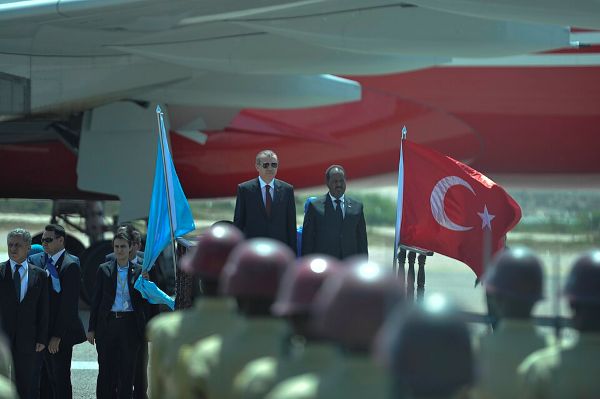
The final week of January witnessed an intense surge in Turkish activity in Somalia. Ankara has decided to deploy F-16 fighter jets to its close Horn of Africa ally, while more than ten Turkish cargo aircraft landed in Mogadishu. Simultaneously, the Turkish National Assembly approved an extension of the mandate for Turkish naval forces operating in Somali waters, and the National Security Council formally elevated Somalia to a strategic priority. Taken together, these moves underscore Turkey’s deepening commitment to the war-torn country.
Turkey has invested heavily in Somalia over the past decade. From port and airport management to financial and humanitarian assistance, infrastructure development, and cultural engagement, Ankara has emerged as the most influential external actor in the country. At the core of the Turkey–Somalia partnership lies security and military cooperation. In 2017, Turkey established Camp TURKSOM near Mogadishu, where Turkish officers train Somali security forces. Ankara has also helped establish elite units within Somalia’s special forces, such as Gorgor and Haramcad.
Beyond training, Turkey has supplied military equipment (most notably Bayraktar TB2 UAVs) and has conducted strikes against the al-Shabaab terrorist organisation. In addition, the two countries signed a landmark maritime security agreement in 2024. Under this deal, Turkey committed to reconstructing, equipping, and training the Somali Navy. The agreement also assigns the Turkish Navy responsibility for safeguarding Somalia’s territorial waters.
A second agreement expanded Turkish involvement in Somalia’s energy sector, granting Ankara a role in offshore and onshore exploration and extraction, with the possibility of overseeing sales and distribution. This partnership is already gaining momentum, with Turkey expected to commence drilling operations by the end of 2026.
Somalia—and the Horn of Africa more broadly—is of vital strategic importance due to its geographic location, mineral wealth, and long-term development potential. For Turkey, presence in the Horn aligns with its leadership’s increasingly assertive approach to regional power projection. Similar policies have been pursued in Djibouti and Ethiopia, and to a lesser extent Kenya.
Somalia represents the crown jewel of Turkey’s Africa policy. Over the past two decades, Ankara has signed numerous economic and security agreements across the continent, including arms exports and military training programmes. Comparable strategies have been applied in the Sahel and the Maghreb, reinforcing Turkey’s ambition to establish itself as a key security partner in Africa.
However, Somalia and the wider region remain politically fragmented, unstable, and insecure. Turkey’s decision to deploy F-16s, alongside its recent military and naval activities, signals Ankara’s determination to protect its investments and strategic assets. This is not unprecedented: in 2020, Turkey reportedly deployed NATO-grade military equipment—including F16 jets— in support of Azerbaijan during the Nagorno-Karabakh war. The Somali case, however, differs in that the deployment of fighter jets could prove a decisive factor given the scale of security challenges Somalia—and by extension Turkey—faces.
Several critical challenges persist. The capital Mogadishu remains under constant threat from al-Shabaab, al-Qaeda’s Somali affiliate, which controls large areas of central and southern Somalia. Turkish companies manage Mogadishu Port and Aden Adde International Airport, while Turkish state-affiliated institutions and NGOs—including the Turkish Cooperation and Coordination Agency (TİKA)—maintain a significant presence in the capital. Reports have also surfaced suggesting that Turkey is planning to construct a rocket launch site in Somalia as part of its space ambitions. Collectively, these assets require effective protection.
At sea, Turkey’s expanding footprint, reinforced by the 2025 strategic fisheries agreement and the 2024 energy deal, faces growing threats from illegal fishing and resurgent piracy. Maritime insecurity poses a direct risk to Ankara’s economic and strategic interests.
Political fragmentation further complicates the landscape. Internal divisions allow external actors to challenge Turkey’s position. Israel’s recent recognition of the breakaway Republic of Somaliland illustrates how rival states may exploit Somalia’s vulnerabilities. Meanwhile, the de facto secession of Puntland and Jubaland following the 2024 constitutional crisis has opened space for increased foreign penetration, particularly by the United Arab Emirates.
Domestic instability is compounded by regional volatility. Neighbouring states grapple with internal conflicts, fragmentation, and strained bilateral relations, creating opportunities for third actors to expand their influence. In this context, the region has become a focal point of intensifying great-power competition involving several regional and global powers. This evolving environment threatens Turkey’s long-term investments and strategic objectives.
In conclusion, Turkey’s primary goal remains the preservation of Somalia’s survival as a state in order to maintain its influence in this strategically vital yet volatile region. Yet rising security threats and intensifying regional competition continue to pose serious obstacles. Ankara’s recent actions indicate a willingness to address these challenges through the use of hard power, signalling a new and perhaps even more assertive phase in Turkey’s engagement with Somalia.