
Ukrainian President Volodymyr Zelenskyy stated on Tuesday that Russia has not succeeded in “breaking Ukrainians” nor achieved victory in the ongoing conflict, even four years following the invasion that has profoundly tested the resilience of Kyiv and its allies. This situation has also heightened concerns across Europe regarding the extent of Moscow’s ambitions.
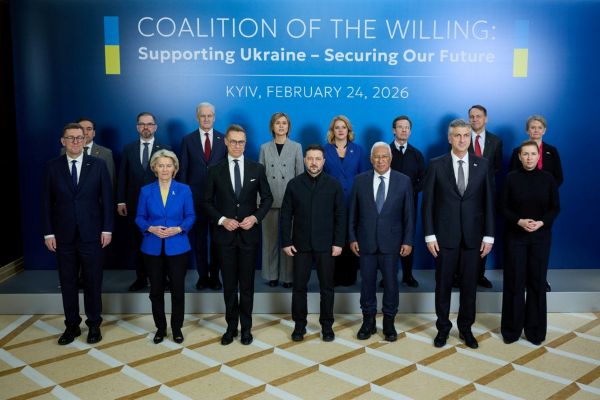
In a demonstration of support, over a dozen senior European officials visited the Ukrainian capital to commemorate the sombre anniversary of the war, which has resulted in the loss of tens of thousands of lives, severely affected the daily existence of millions of Ukrainians, and contributed to instability beyond Ukraine’s borders.
President Zelenskyy emphasised that Ukraine has effectively withstood Russia’s larger and more technologically advanced military offensive. According to the Institute for the Study of War, a Washington-based think tank, Russia has captured only 0.79% of Ukraine’s territory in the past year of fighting. Currently, Russia occupies nearly 20% of Ukraine.
“Looking back at the beginning of the invasion and reflecting on today, we have every right to say: We have defended our independence, we have not lost our statehood,” Zelenskyy said on social media, adding that Russian President Vladimir Putin has “not achieved his goals.”
“He has not broken Ukrainians; he has not won this war,“ Zelenskyy said.
Despite showing defiance, Ukraine has struggled to repel Russia’s attacks, causing significant hardships for civilians. Russian air assaults have devastated families and cut off power and water. In a recent meeting with FSB officials, President Putin did not address the war’s anniversary or its current status but noted an increased threat from Ukrainian attacks on Russian territory. Ukraine has been deploying long-range drones to target oil refineries, fuel depots, and military logistics hubs over 1,000 kilometres (600 miles) into Russia.
UN urges an immediate ceasefire
As the war enters its fifth year, a US-led diplomatic effort to end the largest conflict in Europe since World War II is struggling to find a compromise. Negotiations are stalled over the future of the Donbas, mostly occupied by Russian forces, and Ukraine’s demands for postwar security to prevent further invasions.
On Tuesday, the UN General Assembly called for an immediate ceasefire and a comprehensive peace agreement, rejecting a US push to remove language emphasising Ukraine’s sovereignty and territorial integrity. US Deputy Ambassador Tammy Bruce stated that while Washington supports a ceasefire, it opposed the language as a distraction from peace talks. The resolution was approved by 107 votes to 12, with the United States among 51 abstentions.
Zelenskyy says Trump should witness the suffering
At a makeshift memorial in Kyiv’s central square, President Zelenskyy urged US President Donald Trump to visit and witness the suffering in Ukraine firsthand, saying, “Only then can one truly understand what this war is really about.“
Trump has frequently changed his stance on both Zelenskyy and Putin over the past year, sometimes criticising Ukraine while at other times condemning Putin’s actions. Kremlin spokesperson Dmitry Peskov stated that the invasion would continue to meet Moscow’s demands, which include Ukraine renouncing its NATO ambitions, reducing its military, and ceding territory. Zelenskyy also said he expected new U.S.-brokered talks with Russia within the next 10 days.
A ‘nightmare‘ for Ukrainians
The number of soldiers killed, injured, or missing on both sides could reach 2 million by spring, with Russia facing the highest troop deaths for a major power since World War II. European leaders are concerned about their security, fearing that Putin may target their countries next.
German Chancellor Friedrich Merz wrote on X that “for four years, every day and every night has been a nightmare for the Ukrainians — and not just for them, but for us all. Because war is back in Europe.“
“We will only end it by being strong together, because the fate of Ukraine is our fate,“ he added.
Putin’s dangerous gamble
Western officials and analysts suggest that Putin believes his larger army has the advantage of time, thinking that Western support for Ukraine will diminish and that Ukraine’s military efforts will ultimately fail. Although President Trump has stopped new military aid to Ukraine, other NATO countries are purchasing American weapons and providing them to Kyiv.
French President Emmanuel Macron characterised the war as “a triple failure for Russia: military, economic, and strategic.”
The war “has strengthened NATO — the very expansion Russia sought to prevent — galvanised Europeans it hoped to weaken, and laid bare the fragility of an imperialism from another age,“ Macron said on X.
The European Union has provided financial aid to Ukraine, but some member states, such as Hungary and Slovakia, have been reluctant to support this effort fully. While NATO has backed Ukraine, Russia has received assistance from allies such as North Korea, which sent troops and artillery; Iran, which supplied drone technology; and China, known to provide machine tools and chips.
On Tuesday, key European officials visited Kyiv, including António Costa, President of the European Council, and Ursula von der Leyen, President of the European Commission, as well as several prime ministers and foreign ministers. The only American official present was Lt. Gen. Curtis Buzzard, representing NATO. British Armed Forces Minister Al Carns called Russia’s war on Ukraine “the most defining conflict“ in decades, highlighting the crucial role of drone technology, which accounts for most battlefield casualties.
Both sides are struggling to find enough troops and are increasingly relying on uncrewed aerial drones for remote attacks, according to the International Institute for Strategic Studies. The United Kingdom announced a new military and humanitarian support package for Ukraine on Tuesday, including training for Ukrainian medics.
Rebuilding Ukraine could cost nearly $588 billion over the next decade, according to a report by the World Bank and other organisations, which is almost three times Ukraine’s estimated GDP from last year.
