
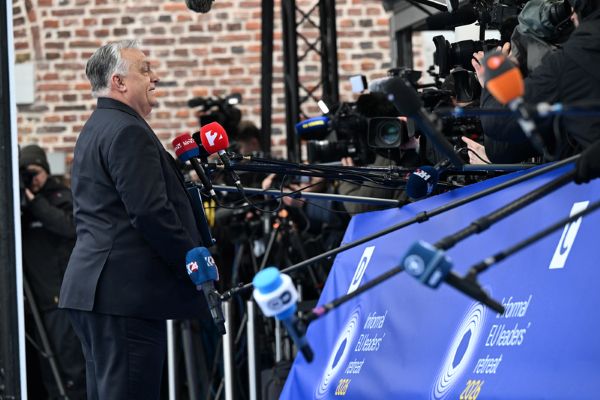
European Union leaders expressed strong criticism of Hungarian Prime Minister Viktor Orbán on Thursday. They accused him of obstructing the delivery of essential aid to Ukraine and of undermining the EU’s decision-making process to gain an electoral advantage in Hungary.
In an unusual public rebuke of a fellow member, the leaders emphasised that Orbán must adhere to the December decision made by the 27-nation bloc to support Ukraine’s armed forces and its war-torn economy over the next two years. Notably, Orbán had previously endorsed what is considered a crucial lifeline for Ukraine.
“He’s using Ukraine as a weapon in his election campaigning, and it’s not good. We had a deal, and I think that he betrayed us,” Finnish Prime Minister Petteri Orpo told reporters as the leaders gathered for a summit in Brussels.
Ukraine’s economy is in dire straits. EU officials believe that Ukraine needs to secure a significant portion of the €90 billion loan by early May. To achieve this, progress must be made on the EU agreement within the next two to three weeks.
Hungarian Prime Minister Viktor Orbán, viewed as Russian President Vladimir Putin‘s closest ally in Europe and a staunch nationalist admired by US President Donald Trump, is trailing in opinion polls ahead of the 12 April elections. As part of his election campaign, he has portrayed Ukrainian President Volodymyr Zelenskyy as an existential threat to Hungary.
Orbán alleges that Zelenskyy, along with European Commission President Ursula von der Leyen, is attempting to involve Hungary in Russia’s war, which has been ongoing for five years. He claims that his reelection is the only guarantee of peace and security for Hungary. In response, other EU leaders are now challenging Orbán, undermining his assertions that EU institutions in Brussels are against him.
“I have the impression that this is part of his electoral campaign, but in any case we have to respect the decisions that were taken here,” Belgian Prime Minister Bart De Wever told reporters. “It’s unacceptable to decide with the leaders and then after, say ‘but I’m not ready to execute what I decided.'”
Austrian Chancellor Christian Stocker said that “what we decide — and what he has agreed to —must be implemented.” He added that if Orban is using the election as a pretext, then “this is not a valid argument given the situation in Ukraine, the plight of the people in Ukraine, and what we ourselves have decided.”
The ongoing standoff has exposed weaknesses in the EU’s decision-making process, which often requires unanimous agreement among its 27 member countries. Hungary, with nearly 10 million people, is a small fraction of the EU’s 450 million population. Tensions between Ukraine and Hungary have escalated since Russia suspended oil deliveries to Hungary in January due to damage to the Druzhba pipeline, which runs through Ukraine. Ukrainian officials blame Russian drone attacks, while Hungarian Prime Minister Viktor Orbán accuses Ukrainian President Volodymyr Zelenskyy of delaying oil supplies.
Hungary has vetoed the loan package and is blocking new EU sanctions against Russia. To resolve the situation, EU leaders offered to pay for pipeline repairs, and a technical team is in Kyiv awaiting security clearance to inspect the site. However, Orbán has vowed to continue blocking the loan as long as oil shipments to Hungary are halted.
This article used information from The Associated Press.
