
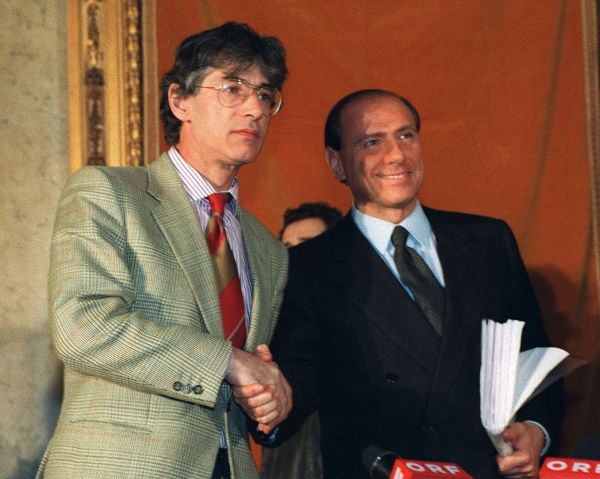
Umberto Bossi, the founder of Italy’s secessionist Northern League and a prominent figure in Italian politics, passed away on Thursday at the age of 84, as announced by his party. His death elicited immediate responses from across the political spectrum. President Sergio Mattarella commended him as “a passionate political leader and sincere democrat,” while Prime Minister Giorgia Meloni acknowledged his “fundamental contribution” to the establishment of Italy’s first modern centre-right coalition.
However, Umberto Bossi was one of the most polarising politicians of recent Italian politics. He effectively capitalised on the potential of a vast movement that arose in Italy’s northern provinces during the early 1980s. By unifying this initially decentralised movement, which encompassed a diverse range of political ideologies from the far left to libertarianism, Bossi significantly reshaped Italy’s post-war political landscape. Beginning in the late 1980s, he articulated the growing frustrations of northern taxpayers and transformed regional grievances into a populist agenda focused on the autonomy of the Northern provinces and, at times, the secession of what he called “Padania”.
His populist slogan “Roma ladrona” (Thieving Rome) crystallised his critique of the central government, perceived as corrupt, and became a rallying cry for a generation of disaffected voters.
However, his party subsequently shifted toward the far-right segment of the Italian political spectrum, incorporating elements associated with post-Nazi ideologies – of the Julius Evola tradition – and racism. By continually portraying citizens from southern provinces in a negative light and advocating for a halt to financial support for the south, Bossi became one of the most polarising figures in Italian politics.
The Northern League has advocated transforming Italy from a unitary state into a federal one, promoting fiscal federalism, regionalism, and greater regional autonomy. At various points, the party has supported the secession of northern Italy and has fomented Padanian nationalism. The party has maintained a consistent stance against immigration and often adopted Eurosceptic views.
In October 1997, Bossi organised what he called “the first elections to the Padanian Parliament.” In an attempt that bordered on the absurd, his entourage presented lists of fictional Padanian political parties, including one named the Communist Party of Padania, with a young Matteo Salvini serving as its president.
Born on 19 September 1941, in Cassano Magnago, a small manufacturing town in northern Italy’s industrial heartland, Bossi entered national politics in 1987. He earned the moniker “Il Senatùr” (the Senator in Lombard dialect) as he ascended to the Italian Senate.
Throughout the following decades, he transformed the Northern League from a small regional party into a significant national force, forming alliances and experiencing unexpected ruptures with the late centre-right leader Silvio Berlusconi. He served twice as a minister under Berlusconi.
A serious stroke in 2004 had a substantial impact on Bossi’s health; however, he remained an active participant in the political landscape for several years thereafter. In 2012, he stepped down as party leader amid a scandal involving the misuse of party funds. Yet, he continued to wield influence as a founding figure of the movement, despite a complicated relationship with the party’s current leader, Matteo Salvini.
This article used information from The Associated Press.
