
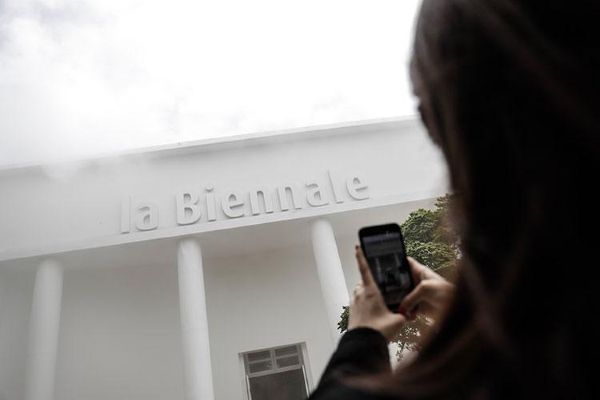
The European Commission (EC) has formally accused the Venice Biennale of violating EU sanctions against Russia, as reported by Artnews. The Commission is also considering suspending EU funding for the event due to the Biennale’s intention to include the Russian Pavilion in its 2026 edition.
Mikhail Shvydkoy, President Putin’s Special Representative for International Cultural Cooperation, announced that the Russian Pavilion will participate for the first time since the invasion of Ukraine, expressing that Russia has remained engaged with the Biennale and is exploring new avenues for creative expression under the current circumstances.
The Venice Biennale is recognised as one of the world’s preeminent art exhibitions. In addition to the official selection, parallel exhibitions take place within national pavilions located in the Giardini area of Venice. Since the invasion of Ukraine in 2022, Russia has kept its national pavilion closed. Nonetheless, for this year’s Biennale, scheduled from 9 May to 22 November, President Pietrangelo Buttafuoco intends to reopen the Russian Pavilion to showcase Russian artists’ work.
This decision has elicited substantial criticism from various quarters, both domestically and internationally, and has come to the attention of the European Commission. In an official statement, the Commission indicated that it is considering freezing funds allocated to Fondazione Biennale, the organisation overseeing the exhibition.
The EC’s correspondence highlights that the inclusion of Russian artists as part of a “governmental delegation,” funded by the Russian government, suggests the Biennale may have accepted indirect support from Russia. Consequently, the Biennale must take steps to “clear its name” in order to prevent jeopardising a $2.3 million grant slated for the 2028 Biennale. The Biennale has until 11 May to respond.
In March, a collective of seventy-three artists and curators issued an open letter urging the Biennale not to include participants from Russia, Israel, or the United States. The Biennale responded by affirming its commitment to cultural dialogue, artistic freedom, and an unwavering stance against any form of exclusion or censorship in the arts.
