
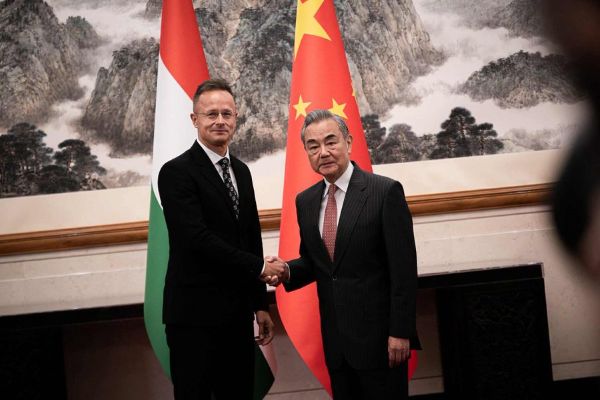
Hungary’s government has announced an investigation into a significant foreign investment by the Chinese automaker BYD, which was facilitated by former Foreign Minister Péter Szijjártó. Szijjártó recently resigned from Parliament to accept an executive position at BYD. His transition to this role has raised concerns about potential conflicts of interest, particularly regarding his involvement in securing substantial government subsidies for the company during his tenure in office.
Prime Minister Péter Magyar addressed lawmakers, stating that during his time as foreign minister, Szijjártó advanced BYD’s interests through considerable public funding, diplomatic support, and contributions to state infrastructure. The investigation will focus on the decisions, negotiations, and commitments made by Szijjártó related to BYD’s investment in Hungary. This review will encompass subsidies, tax breaks, permits, environmental exemptions, and all publicly funded investments granted to multinational firms under the Orbán administration.
Prime Minister Magyar emphasised the need to understand the decision-making process, including who was involved in preparing these agreements, what professional warnings may have been disregarded, and the implications for Hungarian taxpayers, workers, local communities, and the environment. To date, neither Szijjártó nor BYD has addressed the allegations regarding potential conflicts of interest.
In his new role at BYD, Szijjártó has described the position as a “prestigious” opportunity to work for a leading automotive company. Throughout his government service, he played a pivotal role in attracting foreign investments from Chinese companies, including BYD, which received substantial state support.
In 2023, Szijjártó announced that BYD would establish its first European factory in Hungary, enabling the company to avoid European Union import tariffs on Chinese electric vehicles. Furthermore, in 2025, he revealed that BYD would locate its European headquarters and a research and development centre in Budapest, supplemented by 20 billion forints (approximately €55 million) in governmental assistance.
These initiatives have been part of the Orbán administration’s objective to position Hungary as a global hub for lithium-ion battery manufacturing by attracting Chinese battery manufacturers. However, this has prompted residents, environmental advocates, and opposition politicians to express concerns regarding potential environmental impacts and risks to Hungary’s water resources.
Additionally, during his term as foreign minister, Szijjártó maintained strong relations with Russia, even following its full-scale invasion of Ukraine in February 2022. Unlike many of his EU counterparts, he frequently travelled to Moscow to negotiate oil and gas agreements and to engage with Russian Foreign Minister Sergey Lavrov. His activities raised questions during Hungary’s 2026 election campaign, particularly after reports suggested that he communicated with Lavrov during high-level EU meetings to provide updates. Szijjártó has denied these allegations but acknowledged discussions with Lavrov regarding EU foreign minister meetings.
At a recent government news conference, Prime Minister Magyar confirmed that an investigation has been initiated into Szijjártó’s connections to the Russian government.
This article used information from The Associated Press.
