
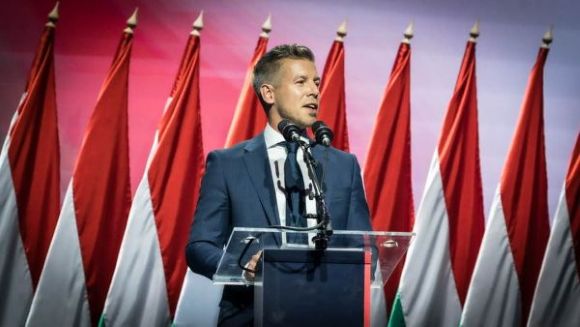
Top officials from the European Union and Hungary’s incoming government are scheduled to meet on Wednesday in Brussels to discuss the critical changes required for Budapest to access €17 billion in EU funds currently blocked due to rule-of-law concerns linked to the previous administration. Among these funds, €11 billion from the post-pandemic Recovery Fund must be utilised by mid-August to avoid irrevocable loss.
Péter Magyar, Hungary’s incoming Prime Minister, announced on Sunday his intention to travel to Brussels for informal discussions with European Commission President Ursula von der Leyen to unblock the frozen EU funds. Magyar emphasised the urgency of the matter, stating, “There is no time to waste.”
The European Commission has confirmed this high-level meeting. Since Magyar’s Tisza party achieved a significant victory in the 12 April election, securing a two-thirds majority in Parliament, both parties have already met twice. This majority enables the incoming government to swiftly enact constitutional amendments, facilitating the necessary legal changes to release the time-sensitive funds.
Commission spokesman Olof Gill explained that these meetings are fully focused on advancing the unblocking of EU funds earmarked for Hungary. “We aim to engage with the incoming Hungarian government in a structured and focused manner to ensure that all necessary actions are taken promptly, allowing the people of Hungary to benefit from these funds at the earliest opportunity,” the Commission spokesman said.
Magyar has identified four key areas where his cabinet can take decisive action to prevent the potential loss of EU pandemic recovery funding by the end of August. These areas include implementing measures to combat corruption and restoring media and academic freedoms.
The discussions are expected to focus on the steps needed to unblock the funds. Still, they may also address additional issues, such as Hungary’s reintegration into the Erasmus student exchange programme, which has been suspended since early 2023 due to concerns about academic freedom.
Furthermore, the agenda may include lifting the outgoing government’s veto on EU reimbursements for military equipment sent by individual EU countries to Ukraine, aimed at supporting its defence against the Russian invasion since 2022.
