
Tomorrow, Armenians will elect their next parliament. The vote arrives at one of the most consequential moments in the country’s post-independence history. Not because it is unprecedented in its drama, but because the stakes behind it are unusually concrete: an unsigned peace treaty, a constitutional referendum in the making, a shattered community of displaced persons looking for political voice, and a regional order still adjusting to the shockwaves of 2023. To read 7 June simply as a referendum on Nikol Pashinyan would be to miss the real architecture of what is being decided.
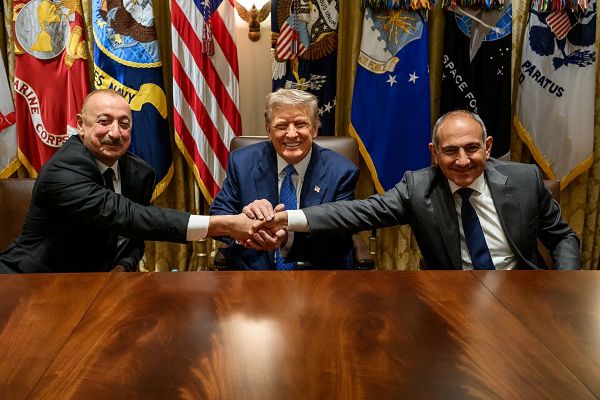
Two events above all have reshaped the country’s political landscape in the past few years: in September 2023, Azerbaijan launched a 24-hour operation that ended the de facto existence of Nagorno Karabakh as an Armenian space. Virtually the entire population fled to Armenia within days. Then, in August 2025, Armenian and Azerbaijani leaders gathered at the White House and, in Donald Trump‘s presence, initialled a peace framework based on the draft peace deal they both agreed to a few months earlier. They did not sign it. The distinction is crucial. One obstacle remains between the initialled text and a binding treaty: Azerbaijan refuses to append its formal signature until Armenia amends its constitution, which contains a vestigial reference to the 1990 Declaration of Independence — language Baku reads as an indirect territorial claim to Nagorno Karabakh. As Aliyev said flatly at the Munich Security Conference in February: “Once the amendment to Armenia’s constitution is made, we can sign the peace agreement the very next day.” Pashinyan has promised a constitutional referendum, likely in 2027. 7 June is the political precondition.
A turbulent race
The electoral landscape presents a paradox: a weakened frontrunner facing a fragmented opposition too divided to capitalise on his weakness.
Opinion polls do not look good for Pashinyan’s Civil Contract party. Roughly 32% of respondents intend to vote for the party, rising to around 38% among likely voters. This is a steep decline from the commanding majorities of 2018 and 2021, and a figure that reflects deep public dissatisfaction. The Civil Contract party failed to secure a governing majority in the March 2025 municipal elections in Gyumri, Armenia’s second city — an early warning of eroding support. The Washington peace agreement, which should be Civil Contract’s signature achievement, remains divisive: polling shows public opinion almost evenly split, with 44% in support and 41% opposed.
The economy has grown under Pashinyan, but residents of Yerevan continue to struggle with rising inflation and a severe real estate crisis, both worsened by the large influx of Russian and Ukrainian nationals since 2022. Nevertheless, the 2021 election results serve as a reminder that polling data can miss the mark entirely.
In any case, Pashinyan remains the frontrunner. The reason is the state of the opposition.
Nineteen parties and alliances are registered. Three main opposition forces are worth examining. The first is the Armenia alliance, led by former president Robert Kocharyan, the dominant parliamentary opposition since 2021. Kocharyan campaigns on restoring ties with Russia, renegotiating the peace terms, and challenging what he calls Pashinyan’s capitulations. Kocharyan’s problem is that many Armenians still associate his presidency (1998–2008) with corruption, oligarchic patronage, and the violent suppression of post-election protests in 2008. His brand of nationalism energises a core but repels the median voter.
The second is the Prosperous Armenia party of wealthy businessman Gagik Tsarukyan, a pro-Russian force with deep patronage networks, whose politics are more transactional than ideological.
The third, and most dynamic new entrant, is Strong Armenia. Its backer is Samvel Karapetyan, a Russian-Armenian billionaire. Karapetyan entered politics in mid-2025 after being detained on charges related to alleged attempts to destabilise the government, charges the opposition calls politically motivated. He was nominated as Strong Armenia’s prime ministerial candidate in early 2026 but was subsequently ruled ineligible: Armenia’s constitution bars dual citizens from parliamentary office, and Karapetyan holds Russian and Cypriot passports alongside his Armenian one. The Parliament then amended the electoral code in ways that further restricted Strong Armenia’s ability to campaign, and in late May, Karapetyan’s nephew and leading party candidate faced a new investigation on unspecified charges. Opponents see a systematic effort to neutralise the one opposition figure with the resources to mount a serious challenge. Government supporters see confirmation of oligarchic interference backed by Moscow.
Despite this fractured opposition, the decisive question for Civil Contract is not whether it wins but by how much. Armenia’s constitution contains a “stable majority” clause: if no party secures an absolute majority, the system triggers bonus mechanisms to give the leading force more than 54% of parliamentary seats. The deeper issue is whether Civil Contract can obtain the political capital — and potentially a supermajority — to drive through the constitutional referendum that the peace process requires. That threshold may prove elusive even in victory.
A polarised society
Armenian society is polarised not merely along the axis of government versus opposition, but along two deeper fissures that the campaign has exposed with unusual brutality.
The first is the question of the Karabakh Armenians. Some 100,000 displaced persons now live in Armenia, stateless in all but name, their citizenship applications largely unprocessed. Many have gravitated towards Strong Armenia, drawn by Karapetyan’s social welfare promises and his outreach. The government’s treatment of this community has become a flashpoint.
In a now-infamous incident in March 2026, a video circulated showing Pashinyan on the Yerevan metro berating a displaced woman — the daughter of a fallen soldier — offering her son a badge bearing a map of Armenia without Artsakh, and declaring that those who fled should not claim he surrendered Karabakh. In a separate campaign episode, he asked a Karabakh Armenian refugee why he was still alive, implying he should have stayed and died defending the enclave.
The reactions were immediate and furious. Critics accused the prime minister of using hate speech against people who had already lost everything. Government supporters argued that the opposition was cynically weaponising displaced persons to block a peace that Armenia cannot afford to refuse.
This fault line is not political in the conventional sense. It cuts through families, communities, and the diaspora. It asks what obligations a state owes to those displaced in its name, and whether accepting peace means accepting amnesia.
The second fissure concerns the Armenian Apostolic Church. The confrontation between Pashinyan and Catholicos Karekin II has been simmering since 2020, when the Church called on the prime minister to resign over the Karabakh defeat. Pashinyan accuses the Church of functioning as a pro-Russian political actor and has alleged that Church figures participated in coup-plotting. The Church, for its part, represents a vision of Armenia as a civilisational and historical nation, with deep attachments to its territorial and cultural memory. For many conservative Armenians, Pashinyan’s “Fourth Republic” agenda looks less like modernisation than like an ideological assault on the foundations of national identity. The ongoing constitutional confrontation is part of this broader cultural war.
Russia, interference, and the stakes for Moscow
No outside power has more to lose from a Pashinyan victory than Russia. Armenia’s foreign policy reorientation since 2020 has been sweeping: Yerevan has frozen its participation in the Russian-led Collective Security Treaty Organisation (CSTO), declared its aspiration to join the European Union, hosted an EU civilian monitoring mission along its borders, and deepened engagement with the United States. Even Secretary of State Marco Rubio has stated publicly that Russia wants Pashinyan to lose.
Moscow’s response has combined pressure with interference. In late May 2026, Russia’s consumer protection agency temporarily suspended imports of Jermuk mineral water — a significant Armenian export. Days later, its agricultural authority restricted Armenian flower imports to Russia. These moves, perfectly timed for the electoral campaign, recalled the economic pressure Russia applied to Moldova and Georgia when those countries pursued European integration. Analysts have documented FIMI (foreign information manipulation and interference) campaigns targeting Armenian social media, employing coordinated inauthentic behaviour and disinformation narratives familiar from earlier Russian operations in the post-Soviet space.
The most dramatic dimension of Russian interference concerns voters, not messages. Between 1st and 17 May, some 10,000 more Armenian citizens entered Armenia from Russia than during the same period the previous year. Western intelligence sources alleged that Moscow intended to bus up to 100,000 Russian-resident Armenian citizens into the country to vote against Pashinyan — though observers noted the figure appeared inflated and that those arriving did not necessarily back the pro-Russian opposition. Armenian military police reportedly began handing out draft summonses to young men arriving from Russia at Yerevan’s airport, a development that added a sharp edge to an already tense atmosphere.
The diaspora’s role cuts both ways. Armenians in the traditional diaspora, particularly in France and the United States — most of whom maintain ties to the Armenian Revolutionary Federation (ARF) — largely oppose Pashinyan and have consistently accused his government of abandoning Nagorno Karabakh, capitulating to Azerbaijan, and sidelining Genocide recognition. But the “Russian diaspora” Armenians represent a different constituency, and the interaction between these communities and domestic Armenian politics has introduced new variables into an already volatile mix.
Elections and foreign policy
Armenia’s diplomatic reorientation represents the most consequential shift in the country’s strategic posture since independence. Yerevan has received substantial EU financial and political support, expanded its diplomatic network to include new bilateral agreements with the United States and China, established relations with Saudi Arabia, and secured recognition from Pakistan. The government has simultaneously sought to preserve trade with Russia and maintain ties with Iran — a multi-vector approach born of necessity as much as strategy.
The peace process with Turkey remains contingent on the unresolved Armenia-Azerbaijan treaty. Progress has been made: the two sides communicate, and there is an implicit understanding that normalisation follows finalisation. But the Turkish border remains closed, and the broader regional connectivity project — the so-called TRIPP (Trump Route for International Peace and Prosperity) envisaged in the Washington framework — depends on a signed peace that Baku continues to hold hostage to Armenia’s constitutional calendar.
What the results will actually determine
A Civil Contract victory would consolidate the current diplomatic trajectory: a push for EU integration, a reduction of Russian dependence, and an attempt to ratify the peace framework through a constitutional referendum. But the quality of the victory matters as much as the fact of it. A thin majority, dependent on bonus-seat mechanisms, would leave Pashinyan without sufficient political capital to secure constitutional change through a referendum requiring broad popular legitimacy. A strong mandate — approaching the level of 2021 — would provide the authority to pursue the Fourth Republic agenda with some prospect of success.
An opposition victory, or a result so fragmented that Civil Contract cannot govern effectively, would open a period of genuine uncertainty. The peace process would stall; Baku’s preconditions would go unmet; and the question of whether the Washington text can survive a change of government in Yerevan would become urgent. Moscow would interpret such a result as a strategic reversal in a theatre where it has watched its influence erode steadily since 2020.
Nearly a third of voters remain undecided or silent as polls close. Their choice will determine not just who governs Armenia for the next five years, but whether a peace initiated in Washington and painfully negotiated over years of military defeat and mass displacement can become permanent — and at what cost to the memory and identity of a nation that has rarely had the luxury of an easy choice.