
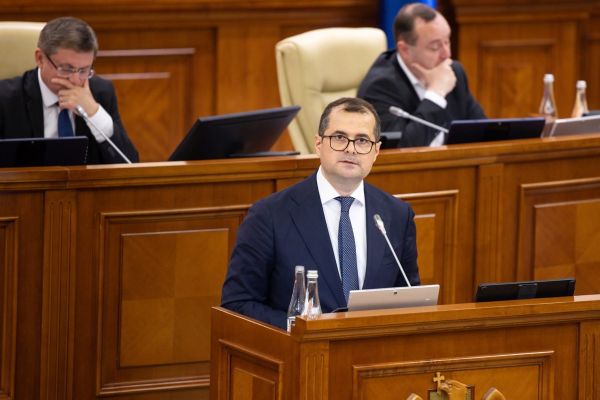
On Tuesday, 22 July, Moldova’s pro-Western parliament elected businessman and investor Vasile Tofan as the new prime minister, entrusting him with advancing the country’s bid to join the European Union. Tofan, 44, supported by President Maia Sandu and her Party of Action and Solidarity, was appointed by a vote of 53 in favour, 21 against, and 21 abstentions in Moldova’s 101-seat parliament.
In his address to lawmakers before the vote, Tofan expressed his commitment to advocating for the interests of all Moldovans, emphasising that he and the new government would operate “with integrity and the determination to move Moldova forward.”
Until recently, he served as a senior partner at Horizon Capital, an investment firm based in Ukraine. Tofan holds a master’s degree in business administration from Harvard Business School, as well as both bachelor’s and master’s degrees in public administration from Erasmus University in the Netherlands.
Tofan indicated that he does not intend to pursue a long-term political career, stating, “I want to complete my mandate and reflect on it with pride for what I have accomplished.”
His appointment follows the unexpected resignation of former Prime Minister Alexandru Munteanu, who stepped down three weeks ago after just eight months in office, triggering the automatic resignation of the entire government. Munteanu cited an inability to exercise his mandate in accordance with his principles and beliefs as the reason for his departure.
President Sandu, who nominated Tofan for the prime ministerial role, underscored the necessity for a united and robust government to facilitate Moldova’s aspiration to join the EU. She has tasked Tofan with forming a new cabinet following the resignations of previous ministers.
Moldova, a landlocked country situated between Ukraine to the east and EU and NATO member Romania to the west, declared independence from the Soviet Union in 1991. Although it predominantly speaks Romanian, the country also has a substantial Russian-speaking minority. In recent years, Moldova has distinctly aligned itself with Western interests, making it a focal point in the geopolitical dynamics between Russia and Europe.
As part of their EU accession processes, Moldova and Ukraine initiated negotiations last month on a cluster of five chapters that encompass the foundational values and principles of the EU, including the rule of law, respect for fundamental rights, and the functioning of democratic institutions.
Additionally, both countries opened a second cluster last week that addresses foreign relations, security and defence policies, trade policy, development cooperation, and humanitarian aid.
This article used information from The Associated Press.
