
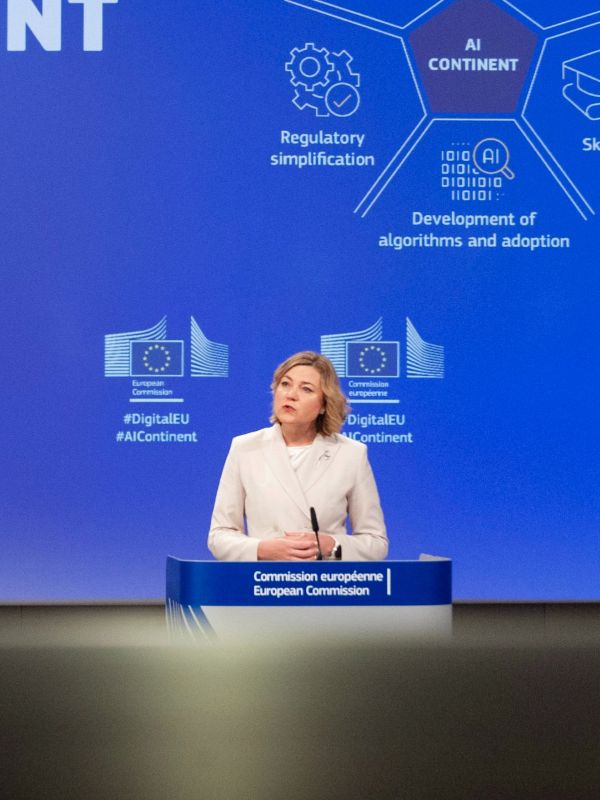
The initial provisions of the Artificial Intelligence Act (AI Act) on the transparency of AI systems entered into force in the European Union on Sunday, 2 August. This legislation mandates that users be informed when they are interacting with AI technologies and that any AI-generated content be clearly labelled. In conjunction with this, the European Union has established a new regulatory team to oversee AI companies globally, representing one of the most rigorous regulatory frameworks the high-tech sector has encountered. This initiative arises in response to escalating concerns regarding the potential risks posed by rapidly advancing AI technology to individuals, political institutions, and economic stability.
“As enforcement begins, we are taking an important step towards AI that people and businesses can understand and trust, and whose benefits are shared widely across our society,” said Henna Virkkunen, Executive Vice-President for Tech Sovereignty, Security and Democracy of the European Commission.
The European Commission aims to monitor the use of AI models for breaches of these new regulations, particularly the dissemination of sexually explicit content, the production of misleading images and videos, and cyber threats to public infrastructure. Upon full implementation of the AI Act, AI companies will be required to clearly indicate to consumers, through labels or digital watermarks, that certain chatbots and visual materials are AI-generated.
The new regulations also address various systemic risks associated with AI, including potential chemical, biological, radiological, and nuclear incidents; loss of control; cyber offences; harmful manipulation; and threats to fundamental rights. This undertaking is part of the EU’s “tech sovereignty“ strategy, which aligns groundbreaking digital regulations with economic ambitions. Recent actions have resulted in significant fines totalling billions of euros imposed on major technology firms, as well as noteworthy investments in AI infrastructure across the EU.
The implementation of these regulations follows several alarming safety breaches in the AI sector that have raised concerns within the industry. Political leaders worldwide are now assessing how to regulate this technology while simultaneously striving to maintain market leadership. For instance, Anthropic recently reported that its AI models compromised three other organisations during testing, shortly after OpenAI disclosed similar concerns about its models.
To enhance its regulatory oversight, the EU is expanding its AI Office in Brussels by adding 38 new personnel to monitor AI companies, ranging from emerging firms to established American and Chinese technology giants. These companies will be required to document specific information, as stated by the European Commission, the regulatory authority, which also has the right to interview staff during investigations. Additionally, the EU has introduced a Whistleblower Tool for technology workers and a Compliance Tool for users to report any unlawful conduct to authorities confidentially.
If AI models or products violate the regulations outlined in the AI Act, the EU has the authority to impose fines or revoke these firms’ access to the EU market. Recent substantial antitrust fines imposed on U.S. tech companies have elicited discontent from US leadership. The EU is acutely aware of its dependence on American software companies such as Amazon, Google, and Microsoft, as well as on Chinese industrial goods and critical minerals. While it seeks to implement protections against AI-related risks, the EU is also determined to enhance its position in the competitive landscape of AI development, where it currently trails behind the United States and China.
More broadly, the EU aims to achieve greater autonomy from both Washington and Beijing by revitalising essential domestic industries, including manufacturing and defence, while also pursuing new trade agreements with nations ranging from Brazil to Australia in response to the rising tide of economic nationalism.
This article used information from The Associated Press.
