
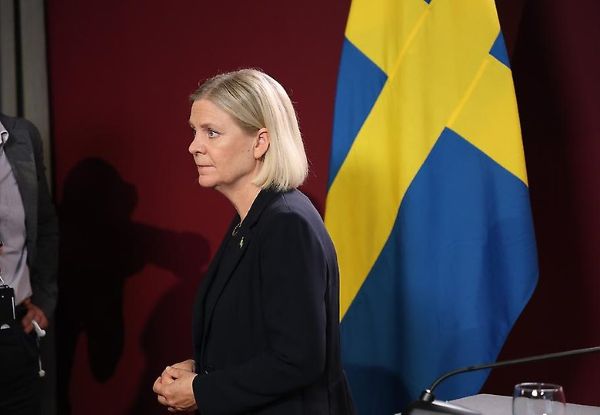
Sweden’s next government remains uncertain as the national election nears its conclusion. Preliminary outcomes indicate a slight lead for the left-wing opposition, while the far-right anti-immigration party has delivered an underwhelming performance. Former Prime Minister Magdalena Andersson is attempting to return to office leading a left-wing coalition; however, her centre-left Social Democrats have seen a decline in support.
So far, with more than 94% of districts counted, the Swedish Election Authority projects that the four opposition parties will secure 176 seats in the 349-seat parliament, the Riksdag. In contrast, the four parties that constitute or support the outgoing government are expected to win 173 seats. The outcome may not be confirmed until Wednesday, when local election boards will count early votes that did not arrive at polling stations by Election Day, including those from overseas.
Andersson addressed her supporters, saying, “We must wait for the final election result,” and added, “Right now we are leading.” Conservative Prime Minister Ulf Kristersson, who has led a three-party centre-right coalition since 2022, said he would explore options given the final results. His coalition relies on support from the anti-immigration far-right Sweden Democrats, a party with neo-Nazi origins that has transitioned toward the political mainstream.
Kristersson remarked, “When we have the final result, it is prudent to consider possible combinations,” emphasising a noticeable non-socialist majority in the Swedish parliament. He acknowledged that this outcome could lead to a complex government-formation process, but he expressed no urgency.
The Social Democrats, under Andersson’s leadership, emerged as the largest single party with just over 28% of the vote, though they lost support compared to the 2022 election. Tensions exist within the opposition bloc, particularly between the Centre Party and the Left Party, with the Centre Party expressing its reluctance to participate in a government that includes the Left Party. Any efforts to navigate across the traditional right-left divide would likely be intricate.
Meanwhile, the Sweden Democrats saw their support drop to just under 18%, down about 3% from 2022, placing them behind Kristersson’s Moderates and into third place. In Sweden, a broad political consensus on several key issues, such as support for Ukraine and the decision to join NATO, led to considerable focus on the potential for the far-right, anti-immigration party to enter government.
The Sweden Democrats’ history was also a prominent topic during the election. Established in the 1980s by individuals associated with right-wing extremist groups, including neo-Nazis, the party has since moderated its rhetoric and expelled openly racist members under the leadership of Jimmie Åkesson, who has guided the party’s evolution from a marginal group to a significant player in Swedish politics.
This article used information from The Associated Press.
