
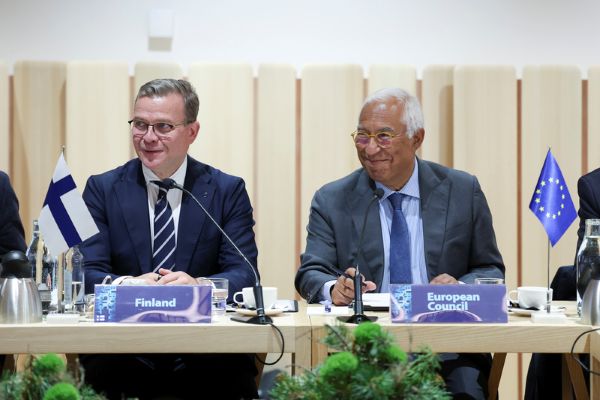
European leaders met on Monday to discuss the escalating competition in the Arctic, where climate change is creating new shipping routes, governments are competing for significant natural resources, and a Russian military build-up is raising security concerns. Key attendees at the European Arctic Summit in Rovaniemi, Finland—home to the Santa Claus Village—include European Council President António Costa, German Chancellor Friedrich Merz, Danish Prime Minister Mette Frederiksen and prime ministers of Nordic countries.
This two-day summit, which commenced on Sunday, follows the recent seizure of a Russian vessel by Norway in the remote Arctic archipelago of Svalbard, an action executed at Ukraine’s request, which drew condemnation from Russian President Vladimir Putin.
During the opening remarks, Finland’s Prime Minister Petteri Orpo underscored the Arctic’s critical importance for European security and prosperity, asserting the need for a “clear picture” and “common understanding” among countries. He stated, “We have natural resources. We have new sea routes because of climate change. But we also have threats. That’s why we need concrete actions. There is so much we can do together.”
The Centre for European Policy Network, a reputable think tank, provided insight into the “extremely dynamic backdrop” for the summit, highlighting factors such as accelerating climate change, China’s increasing trade through the Arctic, and heightened tensions around the Strait of Hormuz, which render the Northeast Passage more significant for maritime shipping.
This meeting serves as a preparatory step for an anticipated overhaul of the European Union’s Arctic policy, expected this autumn, with security now central to the strategy.
Climate change is thinning Arctic ice, which may facilitate a northwest passage for international trade and intensify competition with Russia, China, and other countries for access to the region’s mineral resources. Moreover, the European Union is currently shaping its response to the US administration’s persistent interest in Greenland, a self-governing territory of Denmark, an EU member. The Greenland government has opposed US aspirations for the island.
In a proactive move, European Commission President Ursula von der Leyen recently announced €200 million in EU support over the next two years to help Greenland combat climate change, improve internet connectivity, and enhance hydropower plants, fisheries, and educational initiatives.
This article used information from The Associated Press.
