
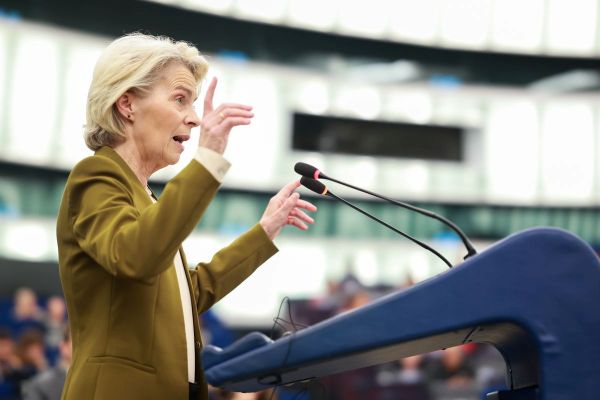
European Commission President Ursula von der Leyen is scheduled to deliver a significant “State of the European Union” speech on Wednesday. In this address, she will lay out her priorities for the coming year and her vision for addressing the challenges facing the world’s largest trading bloc. The specifics of von der Leyen’s remarks to the European Parliament in Strasbourg, France, have been kept confidential, as various political groups within the assembly have advocated including their key priorities and initiatives.
The address is expected to cover critical issues including artificial intelligence, climate change, the recent wildfires that have affected Europe, online protection for children, Russia’s ongoing war in Ukraine, conflicts in the Middle East, and rising international trade tensions.
In remarks from the previous year, von der Leyen underscored the need for Europe to assert its independence amid tariffs imposed by the United States and criticism from the Trump administration over the bloc’s migration policies, which raised concerns about “civilisational erasure.”
“Europe is in a fight,” von der Leyen emphasised, reiterating the importance of defending European values and democracies. She noted that “battle lines for a New World order based on power are being drawn right now,” asserting that the European Union must actively seek its place in a global landscape where many major powers exhibit indifference or hostility toward Europe.
An annual ritual to showcase European ambition
The event has become an annual tradition similar to the US State of the Union addresses. Still, it is not widely broadcast, and few of the European Union’s 450 million citizens are likely to watch. It serves as a staged communications exercise for lawmakers, appreciated mainly by EU insiders.
Ursula von der Leyen often concludes with her rallying cry: “Long Live Europe.” While her themes are aspirational and reflect her plans for the Commission—the EU’s executive branch—critics argue that the Commission’s work lacks transparency and detail.
Eric Maurice, an analyst at the European Policy Centre think-tank, warned against her using it “to placate political groups” or “to raise the Commission President’s profile and extend the Commission’s political and institutional domain.”
“The EU is facing the crumbling of all the premises on which it was built. The rules-based order with benevolent free trade and US friendship and support is disappearing,” Maurice said.
The Commission proposes laws for the 27 member countries and monitors compliance to ensure they are upheld. It negotiates trade agreements and serves as Europe’s top antitrust investigator.
Ursula von der Leyen, a former German defence minister, leads the Commission and has become a prominent figure at international summits despite being a political appointee. Over her seven years in office, she has gained influence by securing COVID-19 vaccines, managing the energy crisis from Russia’s invasion of Ukraine, and supporting Ukraine during the war. While she has earned some respect from US President Donald Trump, the Trump administration has been frustrated by the Commission’s actions against US Big Tech companies for violating Europe’s data regulations.
Ahead of her upcoming speech, the Commission launched a website highlighting its achievements over the past year, including new trade agreements, enhanced economic competitiveness, reduced energy costs, increased defence investments, substantial support for Ukraine, and sanctions on hundreds of Russian officials and organisations.
This article used information from The Associated Press.
