
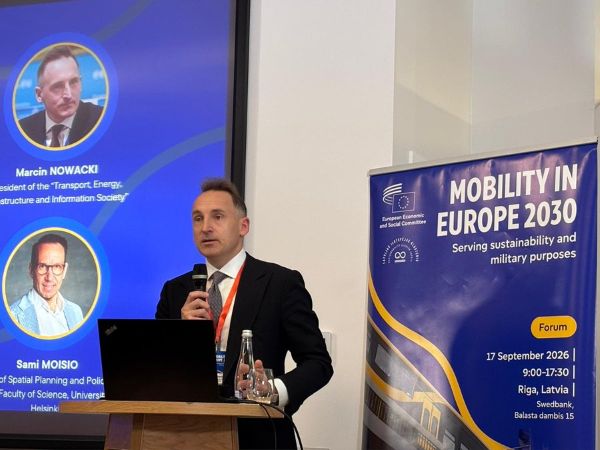
At a high-level event in Riga, the European Economic and Social Committee (EESC), in collaboration with the Latvian association Sustainability Cluster, underscored the urgent need for significant progress in realising the European Union’s vision for an advanced mobility system. Given the rapidly changing international geopolitical landscape, the European Union must intensify its efforts to develop climate-neutral, resilient, and competitive mobility systems, as well as enhance military mobility capabilities.
“Europe in 2030 must be able to move – sustainably, competitively, fairly and securely. Our task is to design a European mobility system in which these objectives do not compete with one another, but reinforce one another,” emphasised Marcin Nowacki, President of the Section for Transport, Energy, Infrastructure and the Information Society, EESC.
This critical message was articulated at the forum titled “Mobility in Europe 2030 – Serving Sustainability and Military Purposes,” convened in Riga on 17 September 2026. Organised by the EESC’s Section for Transport, Energy, Infrastructure, and the Information Society (TEN) in partnership with the Latvian association’ Sustainability Cluster,’ the event gathered representatives from European institutions, national authorities, the business sector, academia, and civil society.
“A sustainable future will not be built by vision alone – it requires decisive action today. Sustainability has become a strategic imperative, shaping our economy, security, mobility and quality of life. The challenge before us is to move beyond isolated projects and short-term solutions and build resilient, interconnected systems capable of meeting the needs of future generations,” stressed Armands Gūtmanis, Chairman of the Latvian association Sustainability Cluster.
The high-level forum served as an essential platform for strategic dialogue, enabling participants to assess current progress, exchange best practices, and outline practical pathways for achieving both sustainable mobility and enhanced military mobility capabilities across Europe.
“Mobility is no longer simply a transport issue – it is a strategic issue. Europe needs infrastructure that serves citizens and economies while strengthening resilience, security and military readiness across borders,” said Baiba Miltoviča, President of EESC’s Permanent Group on Transport.
Focus on the mobility value chain
European mobility faces increasing demands to support the economy, citizens, climate, and security. By 2030, the aim is to improve connectivity across Europe while ensuring sustainability and resilience, leaving no one behind.
Mobility is a strategic priority for Europe and requires a cleaner, more sustainable transport system that is accessible and affordable. Infrastructure must enhance the EU’s competitiveness and stability in a challenging geopolitical landscape.
“European transport mobility has become a fundamental pillar of safety, security and competitiveness, requiring infrastructure to facilitate economic movement while enabling rapid military deployments. Addressing these challenges requires strong EU funding support and cross‑sector cooperation to integrate regional projects, expand energy resilience and build a connected, dual-use transport network,” added Rihards Kozlovskis, Latvian Minister for Transport.
To achieve this, substantial investment in connectivity is critical. The EU should allocate at least €100 billion for transport in the Connecting Europe Facility from 2028 to 2034, ensuring that investments yield European added value and meet social and environmental standards.
“Most of the issues for military mobility are low-hanging fruit – they don’t need a lot of money or time to be solved. I am certain we can find solutions with our Council and Commission colleagues. We have to learn lessons from Ukraine’s experiences and improve our own mobility and security,” said Roberts Zīle, Vice-President of the European Parliament.
The green mobility transition must improve citizens’ daily lives and avoid new inequalities between urban and rural areas. The EU should foster a transport system that is economically strong, environmentally sustainable, and socially responsible while utilising digitalisation to streamline processes and uphold workers’ rights.
