
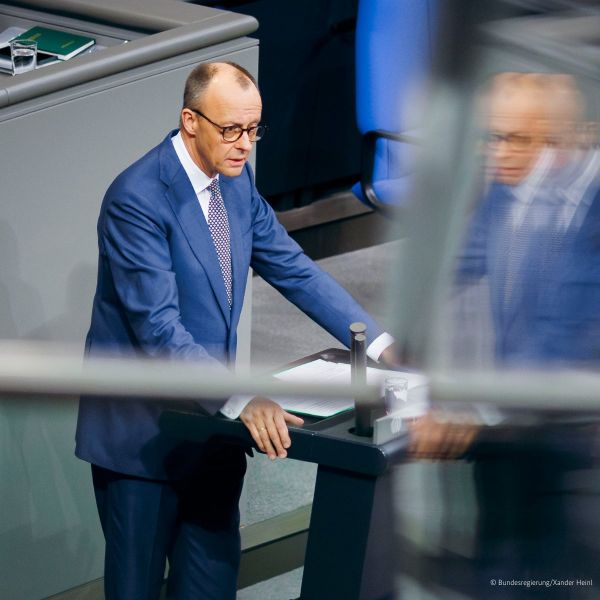
German Chancellor Friedrich Merz faces significant challenges in stabilising his leadership and advancing his agenda after recent electoral setbacks. In the recent regional elections held in Berlin and Mecklenburg-Western Pomerania, the Chancellor’s party, the Christian Democratic Union (CDU), experienced its first ejection from a state legislature in its eight-decade history.
Despite the unfavourable outcomes, Chancellor Merz has committed to continuing his efforts and implementing necessary reforms for Germany, Europe’s largest economy. The final election results underscored what Merz has referred to as a “disaster” in Mecklenburg-Western Pomerania, where the CDU fell just below the required 5% of the vote needed to secure representation in the regional parliament, an unprecedented occurrence in the 77-year history of modern Germany’s federal republic. The party also slipped to second place in Berlin, where the hard-left Left Party is positioned to lead the upcoming city government. Nonetheless, the CDU still has a chance to retain control of city hall, depending on the outcome of coalition talks.
Far-right extremism ante portas again
Neither state is considered a political heavyweight within Germany. The CDU’s victory in Berlin in 2023 marked its only win in the capital in the past 25 years, a region that has historically leaned left. Additionally, the CDU has faced challenges in Mecklenburg-Western Pomerania. The circumstances surrounding its defeat in this area, particularly after a significant loss to the right-wing extremist Alternative for Germany (AfD) two weeks earlier in Saxony-Anhalt, have intensified the challenges for Merz and raised concerns about his leadership.
The AfD emerged as the leading party in Mecklenburg-Western Pomerania. At the same time, the centre-left Social Democrats (SPD), Merz’s junior partner in the national governing coalition, trailed closely behind. Their campaign emphasised state governor Manuela Schwesig as a pivotal figure in countering the AfD’s rise, contributing to increased political polarisation that has affected other mainstream parties, including the CDU. A left-leaning three-party coalition under Schwesig is projected to secure a majority in the newly formed regional legislature.
How should Germany be reformed?
Schwesig and other governing party members have raised concerns about the federal government’s reform agenda, which aims to revitalise Germany’s sluggish economy. The reforms propose overhauling the pension system, reducing bureaucracy, and cutting taxes for low- and middle-income families.
Social Democrats’ leaders reiterated their support for the coalition on Monday but sought modifications to the plans. Vice Chancellor Lars Klingbeil stressed the need for fair reforms that resonate with voters. At the same time, Labour Minister Bärbel Bas called for a “reality check” on the particularly controversial pension changes. She warned against allowing the coalition to collapse over technical issues.
Merz is scheduled for further meetings with party leadership, with support from regional CDU leaders being crucial. While no elections are scheduled for this year, five state elections, including one in North Rhine-Westphalia, are set for next year. Education Minister Karin Prien said a leadership change would not significantly affect outcomes and emphasised the need for the party to gain greater public acceptance and credibility.
This article used information from The Associated Press.
