
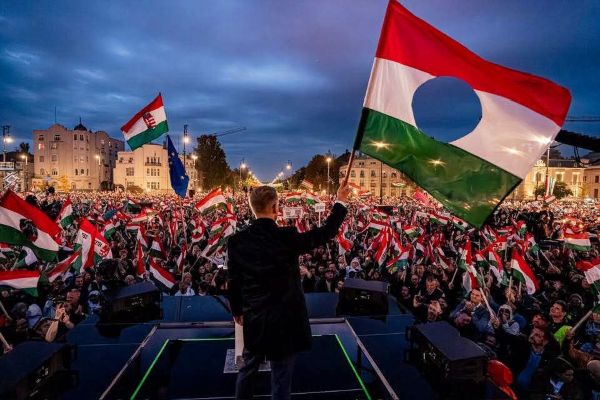
On Friday, several foreign guests from various European countries gathered in Hungary’s capital to mark the 70th anniversary of Hungary’s 1956 anti-Soviet uprising. The gathering also symbolises a new era in diplomatic relations between these countries and Budapest, following former Prime Minister Viktor Orbán‘s recent departure.
Notable attendees included European Commission President Ursula von der Leyen and European Council President António Costa, both invited by the newly appointed Prime Minister, Péter Magyar. Since taking office, Prime Minister Magyar has focused on restoring Hungary’s relations with Europe, which had been under significant strain under his predecessor’s administration.
The former Prime Minister and his far-right Fidesz party consistently challenged the European Union, often obstructing its decision-making processes while aligning more closely with Russia. Orbán’s administration was also criticised for undermining democratic principles and for alleged involvement in widespread corruption, leading the EU to explore alternatives to circumvent his frequently utilised veto powers and to withhold billions in EU funding to prevent misuse.
Since his election victory in April, Magyar has led the centre-right, pro-European Tisza party, which now holds a two-thirds majority in Hungary’s Parliament. Remarkably, within just three weeks of taking office, his government unlocked €16.4 billion in EU funds by implementing the necessary reforms.
On Friday morning, Prime Minister Magyar paid tribute to those who lost their lives during the 1956 uprising by placing flowers at their graves. He later directed a ceremonial raising of Hungary’s flag at Kossuth Square, accompanied by President András Baka and National Assembly Speaker Ágnes Forsthoffer. In an exclusive interview with The Associated Press, Magyar described the Hungarian Revolution as one of the most significant moments in the country’s history and expressed a desire for the world to remember the resilience and passion of the Hungarian people for freedom.
After the revolution succeeded in ousting Hungary’s Stalinist leader in October 1956, Soviet troops re-entered Budapest two weeks later under directives from Moscow, brutally suppressing the uprising and resulting in the deaths of approximately 3,000 civilians while causing extensive destruction. An estimated 200,000 people fled the country, many of whom have not returned.
In the interview, Magyar expressed gratitude for the support of the Hungarian voters, stating, “I am very pleased that the Hungarian voters have assisted us and their country, enabling us to commemorate the 70th anniversary in a truly free, independent, democratic, sovereign, and European Hungary, for which many have fought and sacrificed greatly.” President von der Leyen and the other dignitaries will participate in a formal commemoration in Parliament, followed by a gala performance at the National Opera.
This article used information from The Associated Press.
