
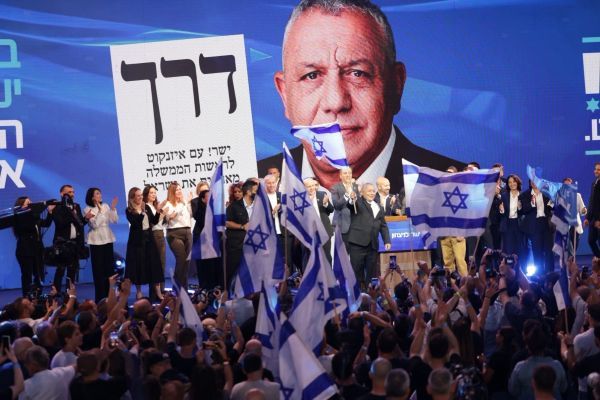
After the last elections, Israel faces uncertainty as no clear winner emerged, and previous promises and the record presence of Arab parties complicate talks of coalition governments.
Latest figures showed that the bloc of outgoing Prime Minister Benjamin Netanyahu won 53 seats, while the main opposition bloc led by Gadi Eisenkot secured 48 seats. The remaining 19 seats of the 120-seat Knesset went to different Arab-led parties, the real surprise winners of Tuesday’s election.
Any possible government needs the backing of 61 MPs, meaning parties now need to negotiate a coalition. The new parliament will take effect on 10 November. Before then, Israeli President Isaac Herzog will have to validate the result and then task one of the main leaders with forming a new government.
Netanyahu, who has been prime minister almost uninterrupted since 2009, could try to lure support from Eisenkot’s coalition; otherwise, he has no viable path to form a government. Before the election, he categorically refused to ever deal with the Arab parties. After the elections, he and his Likud party started insinuating unsubstantiated reports that the Arab parties committed election fraud and were helped by foreign powers.
The Arab parties achieved a historic result, winning 19 seats. They have different ideological positions, but their electorate is mainly the Arab citizens of Israel, roughly 20% of the population. Usually disenfranchised, their turnout in this election, the first after the deadly attacks of 7 October 2023, was higher than before. Many Israelis are calling on Eisenkot to strike a deal to form either a coalition government or a minority government with external support.
However, Netanyahu’s accusations of foreign interference and the opening of an investigation following classified intelligence reports could make it difficult for Eisenkot to seek Arab support. Only in 2021 did an Arab-led party participate in a government coalition.
If no agreement is reached, new elections could follow, which Herzog hopes to avoid. It wouldn’t be the first time in recent years Israel has held multiple elections after failing to form a new government immediately.
