
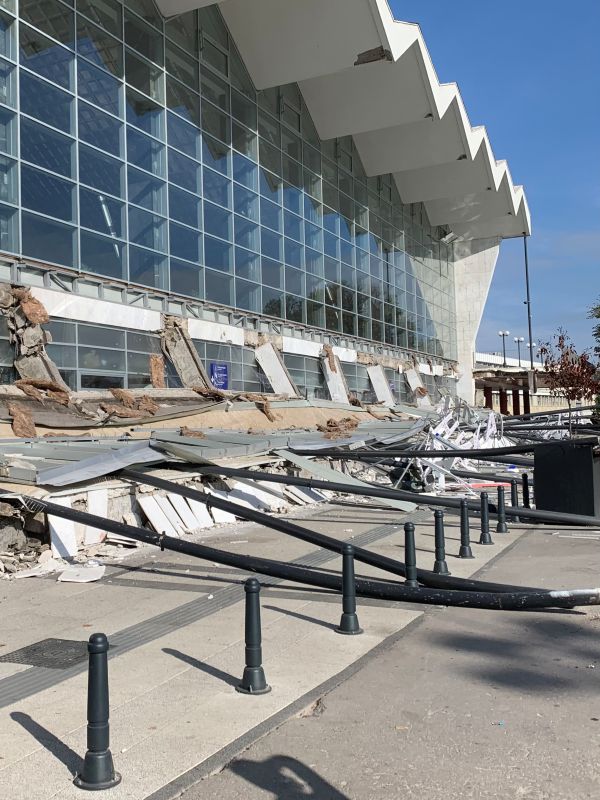
A week after a major student movement successfully unseated Serbia’s long-standing leader, Aleksandar Vučić, in recent elections, thousands of students and supporters gathered on Sunday to solemnly mark the second anniversary of a tragic train station disaster that sparked their anti-corruption campaign. This movement has sought accountability following the collapse of a concrete canopy at the Novi Sad station, which tragically claimed the lives of 16 individuals on 1st November 2024. The ensuing demand for justice fuelled two years of student-led protests, culminating in the remarkable electoral defeat of Vučić’s authoritarian government.
On Sunday, under steady rain and in silence, participants marched in Novi Sad to honour the victims. This year, in contrast to the previous anniversary when large crowds assembled, attendees expressed renewed hope that those responsible for the disaster would finally be held accountable. The students placed 16 wreaths and 16 red hearts—each representing a victim—outside the station, inscribing the names of the deceased, including children, on these tributes. Mourners lit candles and laid flowers in memory of the victims, observing a moment of silence.
At the heart of this uprising against corruption was the belief that the canopy’s collapse resulted from inadequate renovation processes marred by corruption and negligence prevalent in major state infrastructure projects under Vučić’s administration. The station’s renovation was part of a broader railway reconstruction initiative involving partnerships with China and neighbouring Hungary. Notably, Vučić and former far-right Hungarian Prime Minister Viktor Orbán inaugurated the refurbished Novi Sad station in 2022.
During a speech on Sunday, a student remarked, “It was a murder, and a murder demands accountability and justice,” assuring attendees that Serbia’s youth are committed to building a more equitable society. In light of the recent elections, in which the Students’ List triumphed over Vučić’s ruling Serbian Progressive Party (SNS), the students have called for a reevaluation of high-profile investigations, including those related to the canopy collapse. Previously, 13 individuals, including a government minister, faced charges, but the investigation stalled and never proceeded to trial.
Andreas von Beckerath, the head of the European Union mission in Serbia, stated on X that the canopy collapse “shook Serbia to its core and inspired citizens across the country to demand transparency and accountability,” emphasising that “May their memory continue to inspire a Serbia built on solidarity, public trust, and the rule of law.”
Additionally, on the same day, prosecutors ordered a 48-hour detention of Marko Kričak, the chief of criminal police under Vučić, along with another senior officer, on allegations of abuse of office in relation to a murder investigation. Kričak is accused of orchestrating violence during the student protests and allegedly threatening a female student with rape, which he denies.
Since ascending to power 14 years ago, Vučić’s SNS has gradually taken control of various state institutions. The student movement remains steadfast in its commitment to restoring the rule of law and democracy while addressing pervasive corruption that they contend flourished during Vučić’s tenure.
The tragic incident at the station has become emblematic of Serbia’s struggle for the rule of law. On 1st November, 2024, the expansive concrete structure at the outer wall of the Novi Sad station fell unexpectedly at 11:52 a.m., resulting in casualties among individuals waiting for trains on a clear autumn day. Fourteen individuals died immediately, while two others later succumbed to their injuries. One young woman survived but sustained life-altering injuries. Initially, authorities claimed that the canopy had not undergone renovations and initiated an investigation. Protests erupted almost immediately, with demonstrators blocking traffic daily across the country at the exact time of the disaster, calling for justice.
The past two years have witnessed some of the largest anti-government protests in Serbia’s history, largely driven by student-led initiatives. This year, unlike the previous anniversary, state RTS television covered the commemoration, reflecting officials’ recent resignations at the station following the elections. Ceremonies of remembrance were held in various cities and towns throughout Serbia. An independent investigation by a group of experts determined that the renovation work was expedited under political pressure, identifying a “systematic degradation of construction standards” and asserting that the “state of Serbia violated its citizens’ right to life.”
This article used information from The Associated Press.
