
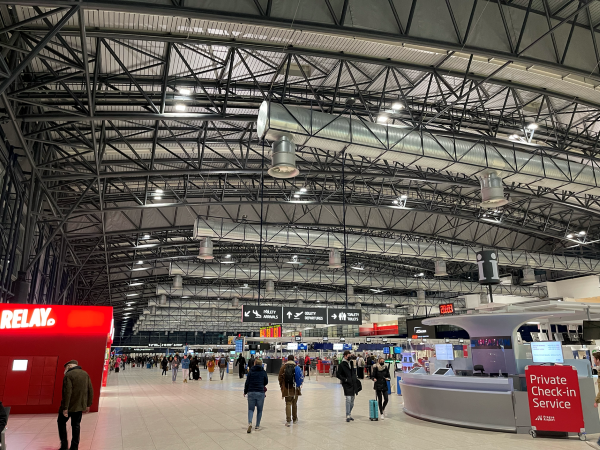
Officials across Europe reported a new wave of bomb threats against multiple flights on Friday, following a series of hoaxes that had already disrupted air travel. Three broadcasters also received security threats, suggesting the issue may extend beyond aviation. Fortunately, no suspicious items have been found, and no injuries have occurred.
Despite the alarm, these threats have had minimal impact on flights. Eurocontrol noted bomb threats against 14 flights on Thursday, just 0.05% of nearly 26,300 flights that day. On Tuesday, seven threats were reported, and 11 more on Friday.
Airlines must take every threat seriously, as they are responsible for passenger safety. Robert Jordan from Britain’s Royal United Services Institute highlighted that secure messaging apps have made it easier for individuals to make anonymous threats.
“The risk appetite for airlines is always going to be incredibly low,” he said, noting the strides made in airport security in recent years. “It is baked into their safety procedures, and it’s baked into their security procedures.”
EU Commissioner for Transport Apostolos Tzitzikostas said that after a meeting with Eurocontrol and the EU’s Aviation Safety Agency in Brussels, security experts are scheduled to meet in the Belgian capital next week to discuss measures to address the bomb threats. “Our priority is clear: the safety of passengers and the smooth operation of European aviation,” he emphasised.
Fighter jets protect passenger planes
In Hungary, the defence minister announced that fighter jets escorted three passenger planes through the country’s airspace on Friday after each received bomb threats. These flights included routes from Brussels to Sofia, Bulgaria, and from Prague to Cyprus and Romania.
French Prime Minister Sébastien Lecornu‘s office reported four bomb threats against aircraft over France, all of which landed safely at Paris’ Orly Airport, where bomb disposal experts conducted inspections. The specific flights affected were not disclosed.
Threats also targeted a Tarom flight from Prague to Bucharest and a Ryanair flight from Lisbon to Rome. Additionally, a Wizz Air flight from Prague to Rome was diverted to Venice and evacuated upon landing.
Eurocontrol is monitoring the situation and working with airlines and airports to minimise disruptions. Nine affected flights were linked to Václav Havel Airport in Prague, affecting routes to Denmark, Spain, Britain, the Netherlands, Cyprus, Italy, and Romania. Czech police reported that security measures were implemented with minimal impact on normal operations.
Travellers expressed concern about the costs of diverting and inspecting flights. In Denmark, police maintained a presence at Copenhagen Airport due to air traffic threats but reported no danger to passengers.
No clear evidence on who is behind the threats
More than two dozen flights were affected by threats earlier this week, prompting diversions as authorities assessed potential risks. While fake bomb threats are common, the frequency of these incidents in such a short time is unusual.
Italian Premier Giorgia Meloni expressed concern over these recent cyberattacks and bomb threats, stating, “We cannot confirm whether these events are connected, but they indicate that civilian infrastructure is under attack.” Authorities have not linked the threats to any specific group or government.
One email sent to airport authorities in Rome claimed to be from an anti-feminist group targeting a “feminist regime.” Another European airport received a similar threat, although it is unclear if they came from the same source.
Paul Reuter, vice president of the European Cockpit Association, acknowledged that bomb threats create tension for pilots but emphasised that crews are trained to respond appropriately. He deemed the use of civil aviation for geopolitical disruption as “totally unacceptable.”
Threats against broadcasters
On Friday, RTE’s Dublin headquarters was evacuated after a bomb threat, halting live broadcasts. Staff returned after police searches confirmed the area was safe.
Irish police, An Garda Síochána, are investigating the threat, while Prime Minister Micheál Martin emphasised how easily such actions can disrupt society. He announced a significant security operation for next week’s European Political Community and EU leaders’ meetings in Dublin.
Separately, UK-based Sky received a “security threat” but continued broadcasting while cooperating with authorities. In Bulgaria, NOVA TV also reported a bomb threat via email, claiming responsibility for threats to European air traffic, but faced no interruptions to its programming.
This article used information from The Associated Press.
