
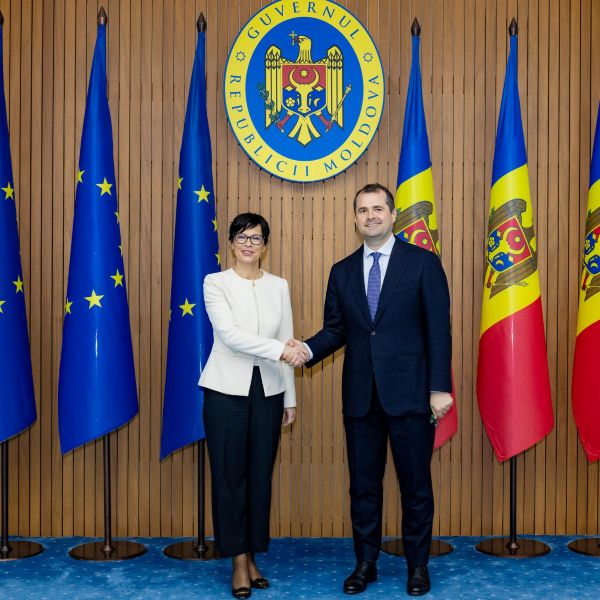
On 9 November, the inaugural High-Level Connectivity Platform Meeting on Digital was held in Chișinău, Moldova, jointly organised by the European Commission and the Moldovan Ministry of Economic Development and Digitalisation. The meeting aimed to lay the groundwork for enhanced digital connectivity between Europe and Central Asia through the Black Sea region, the South Caucasus, and Turkey, and to introduce the Integrated EU Secure Connectivity Offer.
The Platform is designed to leverage European technology, expertise, standards, and financing to bolster secure, trusted, and resilient digital connectivity. It is aligned with the EU’s strategic objectives to develop the Middle Corridor, which will connect Central Asia across the Caspian Sea to the South Caucasus and facilitate direct access to the European market via Turkey and the Black Sea. The overarching goal is to diversify routes, triple trade flows, and significantly reduce freight transit times by 2030.
Notable participants included Commissioner for Enlargement Marta Kos and Moldovan Prime Minister Vasile Tofan, along with ministers responsible for digital transformation and senior representatives from EU Member States, the Black Sea region, Turkey, the South Caucasus, and Central Asia.
“Connectivity is more than an economic priority – it is also about security, resilience, and independence. As the Middle Corridor becomes increasingly important, we are mobilising investments in secure digital infrastructure, working with trusted partners to carry data, knowledge, and innovation across borders. Our goal is clear: to create new, shared opportunities for our people, communities and businesses. Because our common digital future should not be decided for us, it should be shaped by us, together,” said Commissioner Marta Kos.
Representatives from international financial institutions and the private sector also attended. The Integrated EU Secure Connectivity Offer serves as a regional application of the EU Tech Business Offer, as outlined in the EU International Digital Strategy, and aligns with initiatives such as IRIS and policies related to the EU toolbox for 5G security.
Under the Connectivity Agenda Platform, the Offer will facilitate strategic investment projects in trusted digital infrastructure with partner countries by integrating European industry expertise, EU public financing instruments, and security standards along the Middle Corridor. This approach is anticipated to enhance safety, connectivity, and resilience in the region, ultimately benefiting both citizens and the economy.
Transforming regional ambitions into concrete initiatives
The European Commission has formalised Statements of Intent with partner countries, private sector stakeholders, Member State organisations, and international financial institutions. These collaborations are expected to mobilise up to €623 million for investments and technical support in key areas such as 5G networks, space-based connectivity, artificial intelligence, and data centres.
“As Central Asia’s strategic importance grows, so does the need for secure and trusted connections between this region and Europe. Through investments in resilient infrastructure and satellite connectivity, we are helping bridge distances, support economic growth and connect people and businesses across the region, including in the remote and underserved areas. Digital sovereignty and opportunity go hand in hand. And by working together with our partners, we can create lasting benefits both for them and for us,” added Jozef Síkela, Commissioner for International Partnerships.
This funding will support implementation of the Cross-regional Connectivity Agenda, presented at the Cross-regional Security and Connectivity Ministerial Meeting in October 2025 and part of the EU’s broader Global Gateway strategy.
The Agenda seeks to strengthen transport, energy, and digital connections between the European Union and Central Asia through the South Caucasus and the Black Sea region by coordinating strategic investments and regulatory cooperation.
Furthermore, the European Commission and Moldova have announced the initiation of the WIFI4Moldova initiative, which aims to provide free Wi-Fi access to 30 municipalities in Moldova. These initiatives will strengthen cooperation on secure terrestrial and satellite connectivity, data centre infrastructure, and research and innovation, translating the Connectivity Agenda into viable investment opportunities.
The Connectivity Agenda Platform, launched in June 2026, coordinates investments in transport, energy, and digital connectivity. An energy meeting is set for 2027, and the 2nd Connectivity and Security Ministerial will occur in Brussels on 16 November.
