
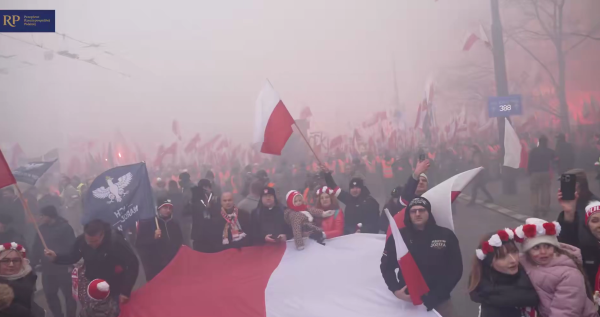
Polish President Karol Nawrocki participated in a major march on Wednesday, joining hundreds of thousands of right-wing demonstrators waving red-and-white national flags and chanting patriotic slogans to celebrate the country’s Independence Day. This annual event, organised by nationalist and far-right groups, comes at a time of heightened concern regarding violent extremism, particularly following a tragic shooting incident in the tourist centre of Kraków on Saturday, which authorities have linked to a right-wing extremist gunman.
Before the march, speakers delivered impassioned addresses emphasising historical and Christian themes, reflecting on Poland’s past subjugation under German and Soviet rule. One speaker specifically criticised “toxic ideologies” circulating online, signalling a strong commitment to patriotism.
While President Nawrocki participated in the march, he engaged from the back of the crowd without addressing the entire gathering. Reports indicated attendance figures ranging from approximately 250,000, according to the PAP news agency, to half a million, according to organisers.
Earlier in the day, President Nawrocki addressed an official commemoration at Pilsudski Square, where he laid a wreath at the Tomb of the Unknown Soldier. During his speech, he outlined security concerns. He underscored the importance of national unity, stating, “Poland will be a solid, stable, and predictable ally in terms of security, with Polish political leaders focusing on building safety for all citizens rather than engaging in political disputes.”
In contrast, Prime Minister Donald Tusk, representing a pro-European stance, attended a separate rally in Szczecin, near the German border. Through a video posted on his X account, Tusk expressed a desire for collaboration, saying, “Today, on 11 November, we were supposed to reach out to one another.” He later remarked that President Nawrocki missed an opportunity to promote unity among Poles.
In recent weeks, Poland has experienced rising divisions, though the country has come together in mourning the tragic events in Kraków. Political factions have been at odds over appointments to the Constitutional Court. The gatherings coincided with the 108th anniversary of Poland’s regained independence after a century of partition by Russia, Germany, and Austro-Hungary. 11 November is profoundly significant for a country that has endured the trauma of lost sovereignty. It is noteworthy that this annual march, organised by nationalist groups, has previously encountered instances of violence.
This article used information from The Associated Press.
