
Bulgaria is heading into early elections on 19 April, its eighth parliamentary election in just four years, amid ongoing instability, protests, and renewed corruption allegations. Since joining the eurozone on 1 January, Bulgaria has continued to face political upheaval, with parties struggling to form stable ruling coalitions since 2021, resulting in a fragmented parliament.
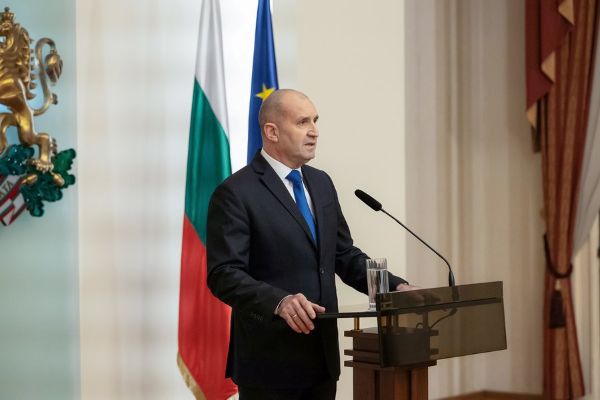
Former Bulgarian President Rumen Radev‘s new alliance, Progressive Bulgaria, is currently leading opinion polls with an anti-establishment message that challenges the country’s stability. Recent polls suggest that Radev’s candidacy is reshaping the political landscape, particularly affecting the national-populist and Russophile factions, potentially hindering smaller parties from entering parliament again. His Russophilia may also create new conflicts within the EU if Radev becomes prime minister.
Radev, who first became president in 2016 and was reelected in 2021 with the backing of the Socialist Party, was expected to serve his largely ceremonial role until the end of his term in 2026. However, he resigned from the presidency on 23 January, planning to establish a new political party. Radev has been a vocal critic of the coalition government of Rosen Zhelyazkov, which resigned on 11 December following weeks of protests over tax increases and perceived failures to combat corruption.
During this period of political instability, Radev has wielded significant influence behind the scenes and has supported the protests that emerged in early December. He has also expressed scepticism about Bulgaria’s recent decision to adopt the euro and has aligned himself with the Kremlin on the ongoing conflict in Ukraine, opposing sanctions against Russia.
Radev remains one of the most popular figures in Bulgarian politics, largely due to his populist rhetoric. In a January statement, he remarked, “Today’s political class has betrayed the hopes of the Bulgarian people.” He said the Progressive Bulgaria coalition is a response to the aspirations of Bulgarians seeking to dismantle the oligarchic model of corruption, emphasising that its success will depend on the collective voice of the people. The alliance comprises three parties: the Political Movement Social Democrats, represented by Elena Noneva; the Social Democratic Party, represented by Todor Barbolov; and the Movement “Our People,” represented by Atanas Kalchev. Galab Donev and Dimitar Stoyanov will jointly serve as co-chairs of the coalition.
A fragmented parliament
Nine political parties are represented in the 240 seats of the current Bulgarian parliament, known as the National Assembly, contributing to political instability. Right-wing populism, nationalism, anti-EU sentiments and Russophilia constitute a vast inter-party camp while Bulgaria’s EU identity is supported only by three parties. The GERB–SDS two-party political coalition, headed by Boyko Borisov, a member of the EPP Group at the European Parliament, has 66 seats. The liberal Renew Europe member, “We Continue the Change – Democratic Bulgaria” (PP-DB), has 36 seats, while the Alliance for Rights and Freedoms (APS), a party representing the Turkish minority, has 17.
The rest of the political parties sitting in the Bulgarian parliament are Eurosceptic or openly anti-EU, and most of them embrace a hard Russophilia.
The Movement for Rights and Freedoms (DPS) was established by Ahmed Dogan in 1990 in order to provide political support and representation to ethnic minority communities, especially Muslims and Turks, who faced severe discrimination. DPS has experience in a coalition government. However, since Delyan Peevski assumed effective leadership of the movement in 2023, DPS has faced several challenges due to its controversial leader. In fact, Peevski was placed under US sanctions for corruption through the Magnitsky Act mechanism in May 2021. Consequently, the ALDE party and the Renew Europe Group cut any relation with DPS. Peevski then moved the movement in April 2025 to the European Conservatives, Patriots & Affiliates group on PACE, and in May 2025, representatives of DPS attended the far-right CPAC Hungary 2025 event. Holding 29 seats, the DPS could play a kingmaker role if its controversial leader’s figure allowed the rest of the political forces to cooperate with it.
The Russophile camp combines nationalism, populism, racism, anti-vaccine rhetoric and social conservatism in an environment comprising right-wing extremists and former communists.
The extremist and ultranationalist Revival (Vazrazhdane), led by Kostadin Kostadinov, is the most prominent Russofile political force in Bulgaria, ranking third in the October 2024 elections and holding 33 seats in parliament. This party that spreads anti-vaccination and conspiracy theories rhetoric is a member of the extremist Europe of Sovereign Nations (ESN) Group led by the Alternative for Germany (AfD). BSP – United Left is a nationalist left-wing populist and pro-Russia electoral alliance led by the Bulgarian Socialist Party, which has 19 seats.
The right-wing populist There Is Such a People (ITN), led by famous singer, TV host, and politician Slavi Trifonov, has 17 seats and is a member of the ECR Group. Morality, Unity, Honour (MECh), which has 11 lawmakers, advocates for traditional family values, is against the LGBT community, and is also pro-Russian. Finally, the ultra-nationalist Velichie (‘Greatness’) of the Bulgarian businessman Ivelin Mihaylov has 10 seats.
However, the entrance of Rumen Radev’s Progressive Bulgaria will shape the political environment as opinion polls indicate.
A fight for survival
Opinion polls conducted in mid-March also indicate that the next Bulgarian parliament may have 5 rather than 9 political parties. This is because Progressive Bulgaria seems to have a dynamic that will block the five smaller parties from re-entering parliament. These parties are expected not to surpass a 4% threshold to gain representation in the assembly. Moreover, this reshaping of political forces may also facilitate the formation of more stable coalition governments, as 121 seats are required for a majority in the parliament of 240 seats.
Thus, according to the polls, Radev’s coalition could secure between 29% and 31% of the vote. The GERB–SDS coalition is projected to receive approximately 20-22%, while the liberal PP-DB coalition may secure up to 12%. Peevski’s DPS is estimated to obtain around 10%. Notably, the right-wing extremist Revival (Vazrazhdane) party has seen support decline, from 13% in December polls to an estimated 6% to 7%. The other five, BSP-OL, ITN, APS, Mech and Velichie, the polls suggest they may remain out of parliament.
This trend may indicate that Radev’s alliance is successfully engaging with the far-right and nationalist voter base, and that the existing polarisation works in Radev’s favour.
