
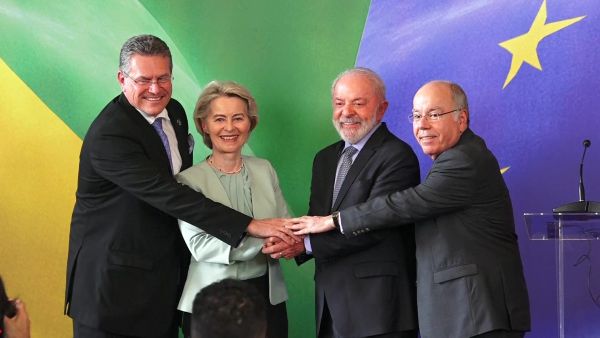
The trade agreement between the South American bloc Mercosur and the European Union, which marks the conclusion of a quarter-century of negotiations, offers some optimism at a time when unilateral actions have dominated the geopolitical landscape. Brazil’s Vice President Geraldo Alckmin, a key negotiator of the agreement finalised in late 2024, announced that it will come into provisional effect on 1 May.
“In a moment that the world much needed it, at a time of protectionism, a tough world, this gives a message that it is possible to open markets,” Alckmin said Wednesday during an interview with media, including The Associated Press, at the presidential palace in Brasilia. “It is the biggest deal between trade blocs in the world. A market of $22 trillion and 720 million people.”
Fierce opposition from farmers and environmentalists delayed the trade deal in December, and it faced further challenges when EU lawmakers referred it to the bloc’s judiciary. The EU executive decided to enact the deal provisionally, bypassing the European Parliament. If the European Court of Justice rules against it, implementation will be halted.
Alckmin emphasised that not finalising the deal with the EU would have left Brazil behind, stating, “It is a win-win situation for both Mercosur countries and the 27 EU members,” with Brazilian exports to the EU expected to increase by about 13% annually.
The transatlantic trade deal was signed on 17 January, and Ursula von der Leyen, president of the European Commission, praised President Lula da Silva‘s administration for its efforts in advancing the deal. Brazil, with a projected 2025 GDP of over $2.3 trillion, is the largest economy in Mercosur. Alckmin also mentioned ongoing negotiations for potential deals with the United Arab Emirates and Canada.
Two decades ago, Alckmin and Lula were on opposing sides regarding various issues, including the negotiations for a trade deal between the EU and Mercosur. While Alckmin, the governor of São Paulo, supported a pact with Europe, Lula did not.
In 2022, the two politicians united to unseat then-President Jair Bolsonaro, whom they viewed as a threat to Brazil’s democracy. Lula appointed Alckmin as his Minister of Trade and Industry, a key role for negotiations.
Lula’s election for a third non-consecutive term did not ensure progress on the Mercosur-EU trade deal. Still, talks gained momentum after US President Donald Trump imposed tariffs on several countries, including Brazil. French President Emmanuel Macron has criticised the deal, calling for safeguards against economic disruption and increased regulations in Mercosur nations. In response to claims about environmental concerns, Alckmin defended these countries’ commitment to preservation.
“If there’s one country that is a role model of environmental preservation, that is Brazil … Brazil reduced deforestation in 50%,” Alckmin said.
“So no one is too scared in either side, if there’s an import boom any of the two (blocs) can ask for safeguards,” he added.
The deal’s full implementation may take up to 12 years, which Alckmin believes is crucial for improving productivity and quality in Mercosur companies. He noted that the fruit, beef, and sugar industries will benefit first, with other sectors following over time.
“It is better to do it gradually than not do it at all,” Alckmin said. “This was a very well-built deal.”
This article used information from The Associated Press.
