
The European Union is quietly preparing for a security response outside NATO, gearing up for a new set of crisis’ games’ to test readiness and cooperation without the US, after months of incendiary rhetoric from US President Donald Trump, underscoring the need for greater independence.
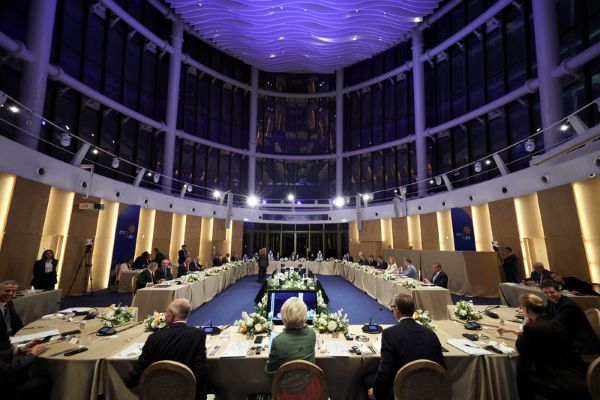
The bloc is hammering out details at a summit in Cyprus for a series of tests to assess best practices for the EU’s military, security, and trade policy. Ideally, those tests will start in mid-May and involve no active troops.
Instead, they will focus on collective assistance in the event of war or an invasion by a foreign power and on developing political decision-making. They will involve heads of state and defence ministries.
The idea is to see what is currently possible to achieve under the EU’s Article 42.7, sometimes dubbed the EU version of NATO’s Article 5. While Article 5 states that an attack on one ally is an attack on the whole alliance, Article 42.7 is more nuanced and was crafted to avoid conflicting with NATO, given that some EU member states are not part of the alliance and some have explicit neutrality clauses – like Ireland and Austria. Therefore, it talks about aid assistance “by all means”, meaning that it doesn’t limit itself to military action. So far, it was called only once, by France in the wake of the 2015 terrorist attacks in Paris.
The current wave of tests is not the first time the EU has decided to train on security response. However, ever since Donald Trump returned to the White House in 2025, the EU has become more wary of a possible disengagement by the US from European security.
In addition to Trump’s cold stance on Ukraine, in recent months, he hinted several times about annexing, even with the use of military force, Greenland, a semi-autonomous territory of Denmark. Some EU member states went so far as to send troops to Greenland in a show of solidarity, prompting the ire of the US President, who threatened sanctions.
This article used information from The Associated Press.
