
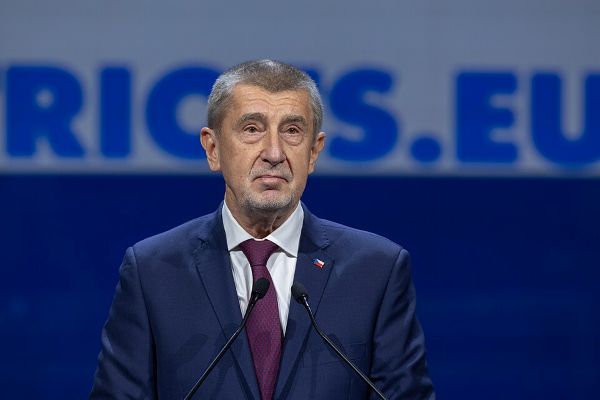
On Thursday, Andrej Babiš, a billionaire and leader of a far-right party in the Czech Republic, announced his intention to transfer ownership of his major businesses to an independent trust as a strategy to enable his return as Prime Minister. He believes this action will mitigate any potential conflicts of interest between his private business dealings and his political responsibilities.
“I’ve decided to irrevocably give up the Agrofert company, with which I will never have anything to do again, I will never own it, I will have no economic relations with it, and I will not be in any contact with it,” he said in a video message.
President Petr Pavel confirmed that he will appoint Babiš as Prime Minister on Tuesday. Babiš, who has previously held the office, controls approximately 200 companies under the Agrofert conglomerate. He stated that an independent trustee would manage Agrofert within a trust, while an independent protector would oversee it until his passing, after which his descendants would inherit it.
Last month, Babiš presented a new government to the President following the success of his ANO (YES) party, a founding member of the Patriots for Europe (PfE) group, in the recent parliamentary elections. However, President Pavel requested that Babiš provide clarifications on how he would address the potential conflict of interest before he swore him in as Prime Minister.
Despite Babiš announcing after the last parliamentary elections that he planned to form a one-party government and seek support from other parties in the parliament, he rapidly changed his mind. He agreed then with two small far-right parties to form a coalition government.
Thus, his ANO party will partner with the Freedom and Direct Democracy (SPD), an extremist party affiliated with the German AfD, and the PfE member Motorists for Themselves. This coalition will include a 16-member Cabinet, with ANO securing eight positions, including the Prime Minister, the Motorists holding four, and the Freedom Party holding three. Babiš promised his partners he would give them critical ministries, such as Foreign Affairs (Motorists) and Defence (SPD).
The coalition parties have expressed critical views toward the European Union, dissented from several of its policies, particularly those related to environmental matters and migration, and have supported Russian views. Additionally, they are anticipated to shift the country’s stance regarding support for Ukraine amidst its ongoing conflict with Russia.
