
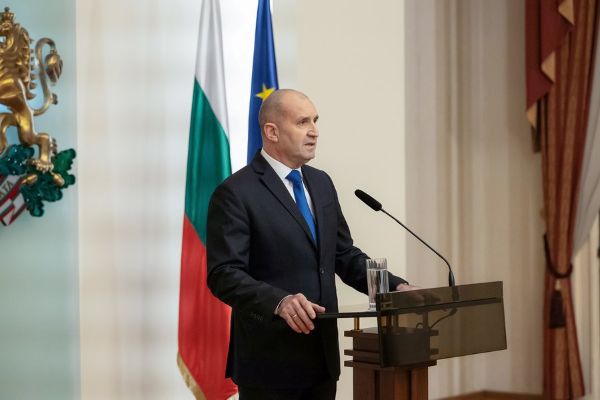
Bulgaria is set for early elections on 19 April, its eighth parliamentary vote in four years, amid ongoing instability, protests, and renewed corruption allegations. As a traditionally pro-Russian nation, foreign interference from Moscow is becoming a growing concern. Former President Rumen Radev‘s new alliance, Progressive Bulgaria (PB), leads the polls with an anti-establishment message that threatens the stability of existing political factions. Since joining the eurozone on 1 January, Bulgaria has experienced significant political turmoil, with parties struggling to form stable coalitions since 2021, leading to a fragmented parliament.
Russia wants Radev
At 62, Radev is seen as the country’s most popular politician and promises a fresh start if his coalition wins. However, Radev’s Russophilia may lead to new conflicts within the EU if he becomes prime minister. President from 2016 to 2026, Radev resigned on 23 January to form a new political party, having been critical of the previous coalition government, which resigned in December amid protests over tax increases and corruption.
During this unstable political period, Radev has supported the protests and expressed scepticism about adopting the euro. He has aligned with the Kremlin on the Ukraine conflict and opposes sanctions against Russia. Radev, known for his populist rhetoric, stated that the PB coalition aims to address corruption tied to the oligarchic model by relying on the collective voice of the people.
This coalition includes three parties: the Political Movement Social Democrats, the Social Democratic Party, and the Movement “Our People,” co-chaired by Galab Donev and Dimitar Stoyanov. Russian interference favours Radev’s party, while Russian support for the extremist Revival has decreased. Bulgaria has also requested EU assistance to counter Russian influence through social media and propaganda efforts.
A fragmented parliament
Bulgaria’s National Assembly has nine political parties among its 240 seats, a situation partly responsible for the country’s instability. The pro-Western parties are: the GERB-SDS coalition has 66 seats, followed by “We Continue the Change – Democratic Bulgaria” (PP-DB) with 36 seats, and the Alliance for Rights and Freedoms (APS), representing the Turkish minority, with 17 seats.
The rest of the political parties sitting in the Bulgarian parliament are Eurosceptic or openly anti-EU, and most of them embrace a hard Russophilia.
The Movement for Rights and Freedoms (DPS), founded to represent ethnic minorities, faces challenges under its leader, Delyan Peevski, who is under corruption sanctions in the USA and the UK. Right-wing extremist Revival (Vazrazhdane) holds 33 seats and promotes anti-vaccine views, while the Bulgarian Socialist Party (BSP) has 19 seats. There Is Such a People (ITN) and Morality, Unity, Honour (MECh) hold 17 and 11 seats, respectively. The entry of Rumen Radev’s Progressive Bulgaria may significantly impact the political scene, according to polls.
A fight for survival
Recent mid-April opinion polls indicate that the upcoming Bulgarian parliament may consist of only 5 political parties, down from 9. This change is largely due to PB, which hinders the five smaller parties from re-entering parliament, as they are not expected to surpass the 4% threshold for representation.
This shift could lead to more stable coalition governments, with a majority requiring 121 out of the 240 seats. Radev’s coalition is projected to secure over 33% of the vote (with some polls showing as high as 38%). In comparison, the GERB–SDS coalition is expected to secure around 19%, while the liberal PP-DB coalition may exceed 12%. The DPS party is estimated to receive about 10%.
Support for the right-wing extremist Revival has dropped from 13% in December to around 7%. The prospects for BSP-OL, ITN, APS, Mech, and Velichie look bleak unless they surpass the 4% threshold—they currently stand at 4% (BSP-OL), 3.7% (Mech), and 3.9% (the 2025-formed anti-corruption Siyanie movement). This landscape suggests that Radev’s coalition is successfully appealing to nationalist voters and that the current polarisation favours him.
In search of coalition partners
Recent polls indicate that Radev is poised to secure first place in the upcoming elections; however, he will need a coalition partner to form a stable governing majority. During his latest pre-election rally on Wednesday, Radev committed to “removing the corrupt, oligarchic model of governance from political power.” Consequently, forming an alliance with Borissov’s GERB or Delyan Peevski’s movement appears unlikely, as he has explicitly ruled out such partnerships.
A viable coalition partner for implementing domestic reforms could be the pro-Western PP-DB alliance. Nevertheless, substantial foreign policy considerations may impede such collaboration, particularly concerning the ongoing issues related to the Russian invasion of Ukraine.
Although Radev has publicly condemned Moscow’s aggression, he has consistently opposed providing military aid to Kyiv. He has expressed a preference for reopening dialogue with Russia to resolve the conflict.
Evelina Slavkova, a representative from the Trend research centre, has suggested that Radev is unlikely to make significant efforts to pivot Bulgaria further towards Russia. “Our country has succeeded, despite facing various obstacles and differences among certain politicians, in developing a robust framework that maintains Bulgaria on the right path,” she said in an interview with The Associated Press.
Slavkova emphasised that Bulgaria’s membership in NATO and the European Union, along with its participation in the eurozone and the Schengen Area, are essential tools that enhance the nation’s stability.
Additionally, she observed that during the campaign, Radev tended to avoid giving unequivocal yes-or-no responses, aiming to balance competing perspectives. “While this approach may be acceptable during a campaign, it becomes imperative to offer clear and definitive answers when governing,” Slavkova remarked.
“Rumen Radev, an Orbán-lite figure, will win a largest portion of the Bulgarian vote. What we don’t know is what he does with it because he’ll need coalition partners. Subsequent elections could well see his Progressive Bulgaria party lose steam. Bulgaria differs from Hungary,” Dimitar Bechev, an experienced analyst and author specialised in Russia, Turkey and the Balkans, posted on 13 April.
This article used information from The Associated Press.
