
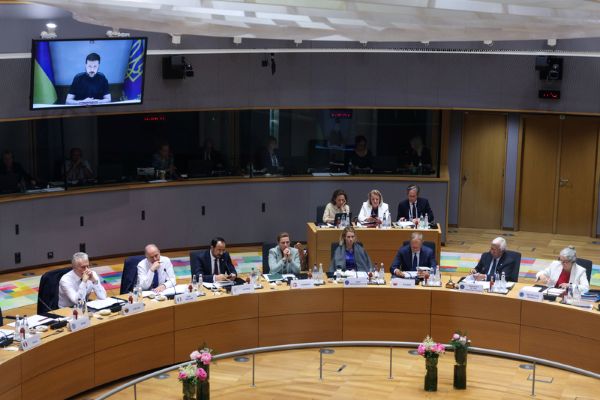
European Union leaders met at a summit in Brussels yesterday to discuss the latest US proposals for a trade deal. Commission President Ursula von der Leyen noted that “all options remain on the table” but also made it clear that the tariff talks could fail.
EU leaders need to arrive at a common position before US President Donald Trump‘s 9 July deadline respite on higher tariffs expires. Failure to do so would leave exporters from cars to pharmaceuticals exposed and under threat.
Germany and France are apparently at odds with one another over how best to proceed. German Chancellor Friedrich Merz is calling on the EU to deliver a “quick and simple” trade deal rather than one that is “slow and complicated”. French President Emmanuel Macron also wants a quick, pragmatic deal but has indicated that France is unwilling to accept terms that are not balanced.
According to Macron, everything must be done to ensure a fair deal, meaning that should the US baseline rate of 10% remain in place, Europe’s response must have an equivalent impact. “Our goodwill should not be seen as a weakness,” he declared.
French officials maintain that the European Commission should take a firmer stance, targeting US services if necessary.
Merz said European leaders were “basically united” about wrapping up the Mercosur trade deal with the South American trade bloc, a deal Macron said he could not support in its current form.
Von der Leyen said the EU only received the latest US document for negotiations yesterday and was still assessing it. One EU diplomat described the US document as a “two-pager, principle agreement”, noting that Washington did not want to get into specific industrial sectors.
The EU bloc is already subject to US import tariffs of 50% on its steel and aluminium, 25% for cars and car parts, along with the 10% tariff on most other EU goods that Trump has threatened could rise to 50% without an agreement.
The European Union has agreed, but not imposed, tariffs on €21 billion ($24.55 billion) of US goods, while additional tariffs on up to €95 billion of US imports are being considered.
The EU bloc is also looking at other issues like support for Ukraine and its prospects for EU membership. In the latter instance, Hungary remained firmly opposed.
“What’s needed now is a clear political message – that Ukraine is firmly on the European path and that Europe stands by its promises,” Ukraine’s President Volodymyr Zelenskyy told EU leaders. “Any delay by Europe at this point could create a global precedent – a reason to doubt Europe’s words and commitments.”
