
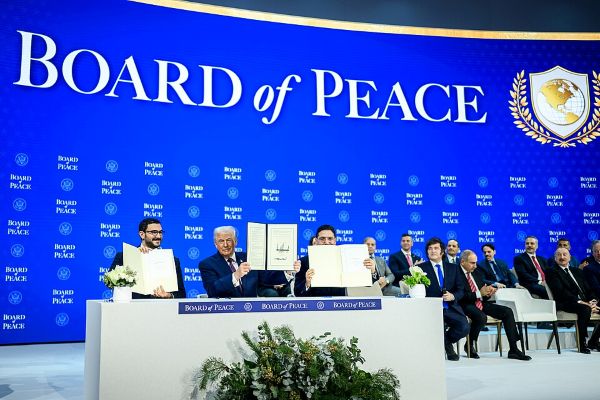
The European Commissioner for the Mediterranean, Dubravka Šuica, will represent the European Union at the Board of Peace meeting hosted by US President Donald Trump in Washington on Thursday. It is important to note that the EU is not endorsing this initiative. In light of this, the Socialist and Democrats group at the European Parliament has requested clarification regarding the details of the Commissioner’s travel.
“Commissioner Šuica will travel to D.C. later this week. She will participate in the meeting of the Board of Peace for the specific part dedicated to Gaza,“ Commission spokesperson Paula Pinho said at a press briefing.
The spokesperson announced that Commission President Ursula von der Leyen received an invitation to the Thursday meeting but will not attend due to concerns about its charter. This indicates that Brussels is not entirely dismissing cooperation with the Trump-chaired Board, despite most EU member states rejecting formal membership. Countries including Germany, France, Denmark, Sweden, Norway, and Slovakia have declined the invitations.
Commissioner Šuica will participate only in the portion of the meeting dedicated to Gaza, reflecting the EU’s commitment to the ceasefire and reconstruction efforts. However, the EU will not join as an official member of the Board.
Italy, Romania, Greece, and Cyprus have accepted invitations to participate as “observers.“ Trump didn’t invite the Baltic states.
EU foreign ministers will discuss this in Brussels next week, along with Bulgarian diplomat Nickolay Mladenov, Trump’s appointee as High Representative for Gaza, who will connect the Board to a Palestinian committee responsible for daily operations.
Observers suggest that the EU aims to play a role in Gaza’s reconstruction, despite ongoing concerns about the Board’s expanded mandate aimed at “global peace.”
Serious concerns over Board’s legality and reliability
The “Board of Peace,“ introduced by Donald Trump, is not part of any recognised international framework and lacks accountability to the parties involved or to the United Nations. This initiative risks bypassing the UN system and centralising political control. A “pay-to-play“ approach for participation raises serious concerns about fairness and the politicisation of peace efforts.
Brussels has expressed worries about the Board’s governance and its compatibility with the UN Charter, which all 27 EU member states have signed. As the largest donor of humanitarian aid to Palestinians, amounting to €1.65 billion since the start of the conflict between Israel and Hamas on 7 October 2023, the EU is wary of being sidelined by the US.
Reports indicate that the Tony Blair Institute has lobbied the European Commission to join the Board, which includes Tony Blair on its executive panel. High Representative Kaja Kallas warned that the Board could exclude Palestinians and ignore international agreements.
Initially intended to oversee Gaza’s post-war transition, the Board has faced criticism, especially since Trump would chair it indefinitely. The presence of Russian President Vladimir Putin and Belarusian dictator Aleksandr Lukashenko complicates the Board’s appeal for EU countries, particularly amid the ongoing war in Ukraine. So far, only Hungary and Bulgaria have accepted invitations to join.
In addition, the unreliability of many initiatives undertaken by the Trump administration during the first year of his presidency raises serious questions about the feasibility of the narrative crafted by Trump’s associates to support this ambitious new project.
European Commission should still clarify why it participates in this meeting
The Socialists and Democrats Group in the European Parliament is asking the European Commission to clarify its role and mandate for participating in the upcoming ‘Board of Peace’ meeting. This initiative contradicts international rules and UN processes, and any EU involvement could undermine Europe’s commitment to multilateralism and international law, as highlighted by the European Parliament, several member states, and Commission members.
“The European Commission must clearly explain its position on this so-called ‘Board of Peace’. There are serious concerns about the lack of transparency, the unclear mandate, and the risks of taking part in initiatives outside the United Nations framework. The Commission’s own statements are contradictory,“ stated S&D vice-president for foreign affairs, Yannis Maniatis.
“Therefore, we call on the institution to urgently report to the European Parliament about its participation in the meeting. This raises real questions about the purpose and authorisation of this engagement, at a time when the EU should univocally defend international law and multilateralism. We need to know who authorised this participation, why, and how the EU will ensure accountability to Palestinians and respect for the United Nations,“ he added.
The Socialists and Democrats Group in the European Parliament maintains that the European Union must be wholly dedicated to a genuine and inclusive peace process grounded in international law and the principles established by the United Nations. Any deviation from this commitment risks establishing a detrimental precedent for the EU’s foreign policy.
