
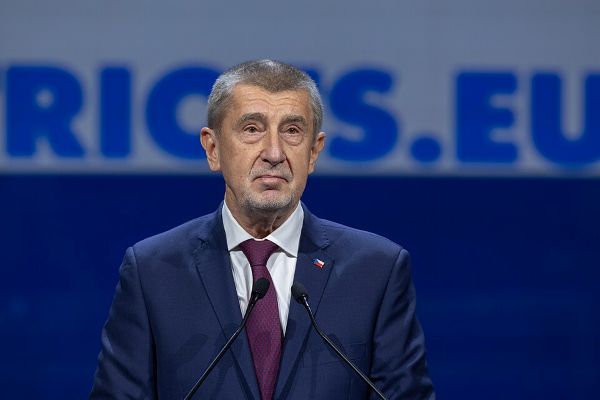
The current pro-Kremlin Czech coalition government, led by Prime Minister Andrej Babiš, has begun implementing changes affecting the constitution. His coalition of far-right and extremist parties – his ANO (Yes) movement, the Motorists for Themselves and Freedom, and Direct Democracy (SPD) – is preparing a law on non-profit organisations, similar to the Russian one. The government has already stopped addressing the Czech Republic’s defence needs and has ceased supporting Ukraine. In this context, Ivan Bartoš, a Member of Parliament for the Pirate Party and former Minister for Regional Development, highlights the troubling steps that would be taken to undermine democratic institutions if such a law is approved.
In an opinion piece published on forum24.cz on March 11, Bartoš notes that an advisor to Prime Minister Babiš, along with deputies from the SPD and ANO parties, is preparing legislation to tighten regulations on non-profit organisations significantly. A recent report from Seznam Zprávy has revealed a concerning draft law, prepared by Natálie Vachatová, an advisor on “freedom of expression” and a member of the small Trikolora party. This proposed legislation reportedly mirrors the Russian Foreign Agents Act and is broader in scope. For example, individuals who post on social media platforms such as Facebook could face fines of up to 15 million CZK for non-compliance.
Similar laws have been implemented in Hungary and Slovakia by their respective authoritarian Prime Ministers, Viktor Orbán and Robert Fico. The introduction of such legislation in Georgia led to widespread protests two years ago.
Ivan Bartoš writes that although the new law purports to offer transparency, it may ultimately serve as a tool to intimidate and undermine non-profit organisations. He draws parallels to practices observed in authoritarian regimes, suggesting that the law could be weaponised against non-governmental organisations, Czech businesses, universities, and researchers.
In response to claims by the far-right ANO and the extremist SPD that the proposed law is simply a Czech version of the American Foreign Agents Registration Act (FARA), the Pirate MP categorically rejects them. He emphasises the core distinction between the American and Russian frameworks: the U.S. FARA primarily targets lobbyists who advocate for foreign governments, rather than non-profit organisations receiving funding from international foundations or European programmes. Conversely, the Russian model broadly categorises various organisations as “foreign-funded,” thereby creating a stigmatising label of “foreign agent” that can significantly restrict their operational viability.
Bartoš further explains that the non-profit sector in the Czech Republic has long been subject to scrutiny, with organisations required to publish annual reports, financial statements, and their funding sources.
He highlights that while the proposed legislation mandates rigorous reporting for non-profits, it provides special exemptions for disinformation campaigns, often associated with Russian sources.
In conclusion, Ivan Bartoš remarks, “Attacks on civil society should not be misconstrued as a defence of freedom. In authoritarian contexts, non-profits are not outright banned; rather, they are systematically constrained through administrative and social pressures.”
A more dangerous law with respect to the Russian model
Seznam Zprávy interviewed Professor Veronika Bílková, a senior researcher at the Institute of International Relations in Prague and a professor of international law at the Law Faculty of Charles University. She is also a member of the Venice Commission of the Council of Europe and serves on the Management Board of the EU Agency for Fundamental Rights.
Professor Bílková noted that the proposed legislation in the Czech Republic employs an expansive definition of “foreign ties,” which could have significant implications for a diverse array of individuals and organisations engaged in activities that may directly or indirectly impact public discourse.
“According to the current wording, the law could potentially affect ordinary Facebook users, as Facebook is a foreign entity that enables individuals to participate in public discussions through their posts,” she explained.
The proposed law stipulates that entities with foreign ties must register in a designated database, provide a comprehensive list of employees, outline their job descriptions, and disclose all relationships with foreign countries, including financial transactions, Professor Bílková told Seznam Zprávy. She added that non-compliance may result in penalties, beginning with fines of one million Czech crowns for even minor administrative infractions, and could lead to a ban on foreign ties or, in extreme cases, cessation of the organisation.
This new legislation is anticipated to have detrimental effects on civil society and cross-border academic collaborations. It raises concerns about a move toward an authoritarian regime, aligning with Vladimir Putin, and could contribute to instability within the European Union.
If approved, the new Czech law would still conflict with both the Czech constitutional order and the international treaties to which the Czech Republic is bound.
