
Since his return to power in 2023, Prime Minister Robert Fico has implemented measures to exert control over the media in Slovakia. Since years, Fico expresses contempt for press freedom, frequently targeting journalists and media institutions. His efforts to restrict media freedom are part of a broader plan to undermine the rule of law in Slovakia.
His government is a coalition formed by his party, SMER, which combines elements of both old communist and far-right ideologies, along with Voice – Social Democracy (Hlas), a breakaway faction from SMER, and the far-right Slovak National Party (SNS). This coalition is characterised by its anti-EU stance, pro-Russian sentiments and an ultra-conservative agenda. Moreover, the three parties lack affiliations within European political structures.
In recent years, Slovakia’s media landscape has been increasingly influenced by the government, amid allegations of political interference. Following his election to a fourth term in 2023, Fico designated four Slovak media outlets—TV Markiza, broadsheet dailies SME and Dennik N, and Aktuality—as “hostile,” subsequently denying some of these organisations access to government press conferences. Consequently, Slovakia has fallen 21 places in the World Press Freedom Index, as reported by Reporters Without Borders.
TV Markiza, which Fico and his allies labelled as “anti-government”, experienced increasing political and internal pressures to align with the governing coalition’s policies. This resulted in the departures of several journalists. The Czech PPF group owns TV Markiza—a media and telecommunications conglomerate with considerable interests in Slovakia’s state-regulated sectors, including telecommunications.
Fico and his coalition have also actively targeted journalists critical of the government, issuing threats of enhanced surveillance, potential lawsuits, or the loss of crucial advertising contracts.
Building an authoritarian state
On December 6, 2023, the newly established government initiated a significant review of the country’s penal code. This proposed reform includes reducing penalties for serious offences and dissolving the Special Prosecutor’s Office. The government faced allegations of implementing targeted personnel changes within the Slovak police and among investigative bodies.
In response, the European Parliament passed a resolution (496 votes in favour, 70 against, and 64 abstentions), expressing serious concerns regarding Slovakia’s ability to combat corruption and safeguard the EU budget if the proposed criminal code reforms were adopted. Members of the European Parliament (MEPs) said potential legislation could undermine civic participation, restrict the activities of non-governmental organisations (NGOs), and discredit organisations that receive foreign funding.
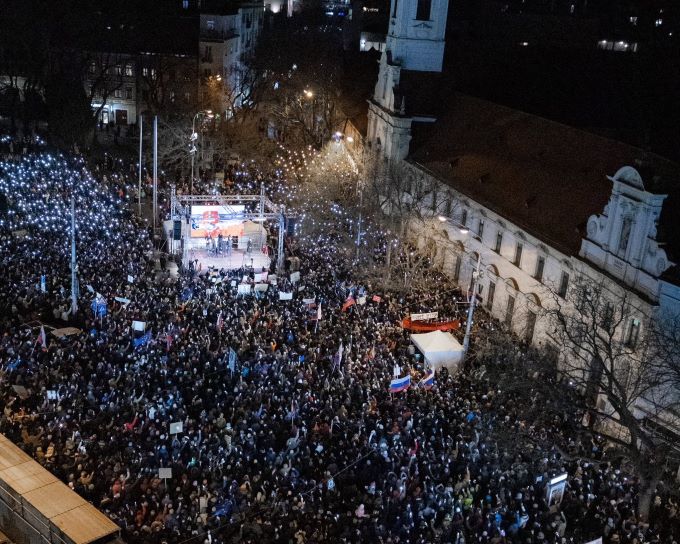
When approved by Parliament in February 2024, the legislation came under fire domestically and abroad. Street protests spread from Bratislava, the capital, to more than 30 cities and towns across the country.
Moreover, the proposed restructuring of Radio and Television of Slovakia (RTVS) has raised further concerns. MEPs expressed disappointment over Prime Minister Fico’s decision, as well as the actions of several government officials, to discontinue dialogue with key media outlets. They have called for an end to the disparaging rhetoric directed at individuals and media representatives, investigating violent crimes, such as the murders of the investigative journalist Ján Kuciak and his fiancée Martina Kušnírová.
The government’s initiative to assume control of the national broadcasting service has resulted in the replacement of RTVS with the state-funded STVR. The European Commission has criticised this move, asserting that it reflects a governmental intent to exert full control over public broadcasting.
Fico’s obsession with the media
Robert Fico has expressed hate against the media and journalists during press conferences. He has referred to specific journalists with terms such as “idiots,” “pricks,” and “prostitutes.” For instance, in November 2016, he labelled journalists questioning him about public procurement allegations as “dirty, anti-Slovak prostitutes.”
Fico views the Slovak press as acting against national interests. In November 2021, he described journalists as part of “Soros’ corrupt gang”. He accused them of “waging a jihad” against him and his party. In 2022, he called journalists an “organised criminal group” aiming to undermine statehood and urged police investigations into their activities.
His return to power appears driven by a desire to confront those who contributed to his ousting from government in 2018, following the murder of Ján Kuciak.
