
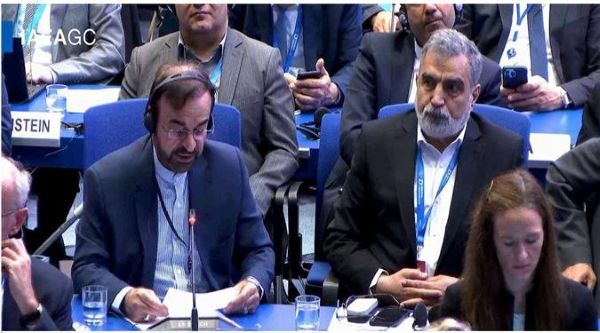
Iran has publicly expressed its discontent regarding the exclusion of the head of its Atomic Energy Organisation from the annual gathering of the United Nations nuclear agency in Vienna. The Iranian government views this action as “a serious breach” of its rights as a member country.
Reza Najafi, Iran’s ambassador to the International Atomic Energy Agency (IAEA), addressed this issue during the general conference, emphasising that the denial of access obstructs Iran’s full and effective participation and contravenes both the letter and the spirit of the legal framework governing attendance at IAEA meetings.
He also criticised Austria, the host country of the IAEA and other UN organisations, for its decision not to grant a visa to Mohammad Eslami, saying the decision undermines the host country’s obligations.
Mikhail Ulyanov, the Russian ambassador to the UN in Vienna, supported Iran’s position, asserting that Austria had “grossly violated” its responsibilities as the host nation of the IAEA. He added that Western nations have launched a “genuine campaign of visa-related abuses” to settle scores with countries they consider undesirable.
Austria says a UN committee denied Eslami’s visa
Iranian Foreign Ministry spokesperson Esmail Baghaei criticised Austria for refusing to issue Eslami a visa, saying Tehran protested the decision and summoned the Austrian chargé d’affaires. Austria said a UN Security Council committee denied its request to exempt Eslami from a travel ban, forcing it to deny entry to one member of the Iranian delegation.
As the host of international organisations, Austria can request exemptions from travel bans, but the UN Security Council’s sanctions committee makes the final decision. These sanctions, reimposed after a snapback mechanism was triggered last year by France, Britain, and Germany, include travel bans and restrictions related to Iran’s nuclear programme.
US Ambassador Preston Wells Griffith said Austria’s exemption request was denied because of a US objection, emphasising that the US could not allow a UN-designated official to travel without significant cooperation on nuclear safeguards.
2025 bombing blocks IAEA from Iran’s nuclear sites
Since Israel and the US struck Iran’s nuclear sites during the 12-day conflict in June 2025, Iran has denied IAEA inspectors access to those areas, violating its obligations under the Nuclear Nonproliferation Treaty. The IAEA has been unable to verify the status of Iran’s stockpile of nearly weapons-grade uranium, which currently stands at 440.9 kilogrammes enriched to 60%. This is just a technical step away from weapons-grade levels of 90%.
Recently, the IAEA’s board reported Iran to the UN Security Council for the first time in 20 years due to its lack of cooperation in investigating uranium traces found at undeclared sites. Western officials suspect these traces may indicate a secret nuclear weapons programme in Iran since 2003, but Iran insists that its nuclear programme is entirely peaceful.
This article used information from The Associated Press.
